Tatsuya Imai Deserves $200M+: The Inflection Point for Modern Pitcher Evaluation

Tatsuya Imai Deserves $200M+: The Inflection Point for Modern Pitcher Evaluation

Written by

Chris Langin

30 min read
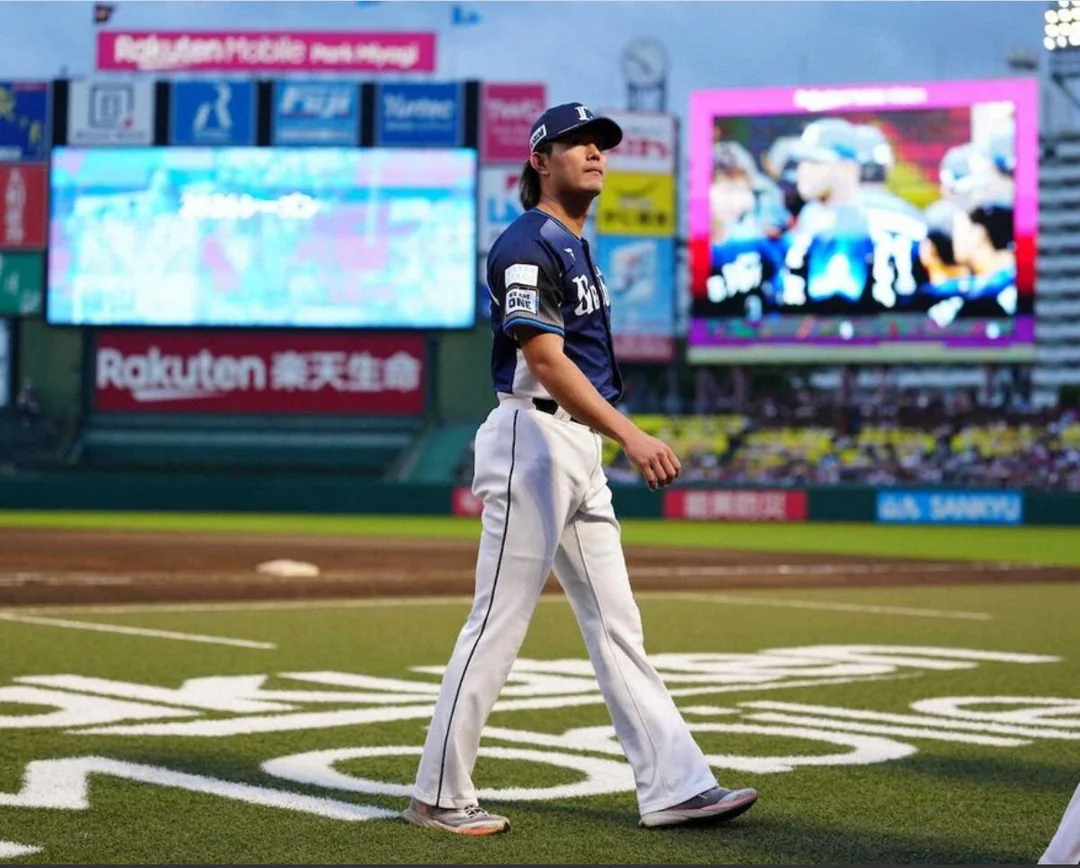
30 min read

30 min read

Why the best performing NPB slider in history will maintain its whiff performance in MLB, and how 2 cultures' reward structure for the upper-third strike makes all the difference in his fastball and command floor.

Why the best performing NPB slider in history will maintain its whiff performance in MLB, and how 2 cultures' reward structure for the upper-third strike makes all the difference in his fastball and command floor.

Why the best performing NPB slider in history will maintain its whiff performance in MLB, and how 2 cultures' reward structure for the upper-third strike makes all the difference in his fastball and command floor.

Introduction

Tatsuya Imai is the inflection point for modern pitcher evaluation.

This piece will cover:

  • Why NPB hitters whiffing repeatedly at his slider tells you more than Stuff+ will

  • Why the environmental change to a rewarded upper-third strike zone weighs heavily in his favor

  • And why these 2 things are the difference between a $25M AAV pitcher and a $32M AAV pitcher

On a 6-year deal, that's a $40M+ swing in total contract value.

I believe Tatsuya Imai deserves $200M+. Here's why.

PART 1: THE FASTBALL

The Profile


Metric

NPB Value

MLB Projection

IVB

~13.5"

~12-13"

HB

~15"

~12"

Spin

2300 rpm

2150-2200 rpm

This movement profile doesn't look good. Until you account for two things.

Tatsuya Imai throws 95 mph from a ~5'0" (152 cm) release point.

This combination is extraordinarily rare for a starting pitcher.

For reference: Joe Ryan has below-average vertical break on his four-seam and below-average velocity. Yet he leads the league in upper-third four-seam usage since 2015. He's only been pitching since 2020.

The Comps


Pitcher

Velocity

IVB

Release Height

Notes

Luis Castillo (SEA)

~95 mph

~12.5"

~5.0'

Premium comp; similar VB + slot + velocity band

Joe Ryan (MIN)

93-95 mph

~13.5"

~4.8'

Elite modern low-slot carry; high-end model

Tatsuya Imai

~95 mph

~12-13"

~5.0'

Same archetype. Can't be taught.

This is structural, not trainable. Which means it can't be mass-produced like sweeper grips. And sweepers saw their quality decline as quantity increased.

Spin Profile vs Notable NPB Arms


Pitcher

Spin Efficiency

Spin Rate

Back Spin

IVB

Imanaga

99%

2500

2000

18"

Sasaki

96%

2100

1400

14.5"

Imai

93-96%

2200

1050

12-13"

Yamamoto

91%

2200

1600

16"

Kikuchi

91%

2175

1500

15.5"

Senga

88%

2400

1700

16.5"

Ohtani

75%

2450

1500

14.5"

Imai's back spin (1050) is notably lower than his peers, but his release height and velocity combination give him a lower vertical approach angle than Shota Imanaga and his high spinning and high vertical break fastball.

Despite Imai having half the backspin as Imanaga, his additional 4 mph and 0.5 feet lower release height give him a flatter vertical approach angle.

Upper-Third Four-Seam Leaders

Since 2015, only 5 pitchers have thrown >2,500 four-seams from a release height under 63 inches:


Pitcher

First Full Season

Pitches

Joe Ryan

2022

3,095

Aaron Nola

2016

3,064

Andrew Heaney

2015

2,793

Craig Kimbrel

2011

2,734

Julio Teheran

2013

2,531

And since Joe Ryan entered the league (2022), the supply has plateaued:


Year

Pitches

% of 4-Seams

Velo

RelH

IVB

Miss%

SwStr%

xWOBA

2022

20,833

8.8%

92.9

4.82

13.1

24.5%

12.3%

.315

2023

24,421

10.6%

93.5

4.92

13.3

24.4%

12.4%

.325

2024

24,542

10.8%

93.4

4.93

12.8

23.5%

12.0%

.305

2025

23,912

10.6%

93.4

4.95

12.8

24.1%

12.4%

.316

Despite the demand for the outcomes, the supply has plateaued at ~10.5% of league four-seamers. You can't manufacture pitchers who throw this hard from this slot.

The league's average IVB in this bucket is actually declining (13.3" in 2023 → 12.8" in 2024-25), meaning teams are actively inputting pitchers into this sample who don't have elite carry — the demand for the geometry is higher than the supply of pitchers who can execute it with quality vertical break.

They're reaching for the slot because the outcomes justify it, even with below-average ride.

Why The Fastball Works: VAA Advantage

A low release point creates a flatter vertical approach angle (VAA).

MLB hitters swing at steep angles, trying to lift the ball. The flatter a four-seam comes in, the greater the mismatch between bat path and ball path.

This is why Joe Ryan's and Luis Castillo's four-seams work — the geometry forces a vertical mismatch that hitters can't adjust to mid-swing.

When you filter for pitchers at league-average release height, the correlation between vertical break and elite VAA is 0.66. Velocity is 0.45. The main mechanisms for improving VAA are more spin/spin efficiency and ride, or throwing harder.

But when you remove that filter — keeping even the middle 35-40% bucket of the population — the correlation between VAA and vertical break doesn't just drop, it becomes -0.3. Velocity has ZERO correlation.

The instant you throw from 5'0" or lower, you soak up massive value in driving the upper limits of this metric, and you have a high floor for whiffs regardless of how much carry you have.

The Logan Webb Example

Logan Webb averages just 10.5" VB on his four-seamer at around 93 mph.

He's a sinker-first pitcher that happens to possess a four-seamer without the usual traits (high spin, high efficiency, high velo) that normally allow for whiff potential with a heater.

He's able to maintain excellent contact suppression with ground balls and generate strikeouts depending on what the context calls for.

Not many pitchers can truly get the best of both worlds. And if they do it normally calls for plus-velocity and command or plus-plus velocity.

Webb is able to at 93 — 2 mph below the league average righty in fastball velocity — because the floor for whiffs at this release height is always there no matter the four-seam shape if you're over 92 mph.

VAA Comparison: Japanese MLB Arms & Primary Comps


Pitcher

Velo

Rel. Height

IVB

VAA

Starter Pctl

Grade

Jacob Misiorowski

99.2

5.26'

16.1"

-3.46°

99%

80

Joe Ryan

93.5

4.77'

13.7"

-3.53°

99%

80

Tatsuya Imai (Proj.)

95.0

5.00'

12.5"

-3.75°

95%

72

Yoshinobu Yamamoto

95.4

5.45'

16.0"

-3.85°

92%

69

Yusei Kikuchi

94.7

5.38'

15.5"

-3.90°

90%

67

Luis Castillo

95.0

5.17'

12.4"

-3.93°

89%

66

Shota Imanaga

90.8

5.45'

18.0"

-3.97°

87%

65

Shohei Ohtani

98.3

5.68'

14.7"

-4.07°

80%

61

Kodai Senga

94.7

5.93'

16.6"

-4.39°

51%

50

Roki Sasaki

95.8

6.13'

14.6"

-4.80°

16%

40

Imai projects as the third-flattest VAA among this group — trailing only Joe Ryan and Jacob Misiorowski among starting pitchers — despite having the lowest IVB in the entire comparison.

His release height + velocity combination does all the work.

Note that Misiorowski generates his elite VAA with both low slot AND elite velocity (99.2 mph). Imai achieves 95th percentile VAA with average-ish velocity (95 mph) purely through release geometry. This is the structural edge that can't be trained.

The Floor

Pitchers within this bucket still differentiate by how low they are, how much vertical break they have, and how hard they throw. But if Imai throws 95 mph from this release height and generates anywhere near 12 inches of vertical break, he has access to the region of the dataset where 70-grade achievers live just by throwing his four-seam.

He immediately enters 90th-95th percentile territory.

The fact that MLB hitters average 6'2" compared to NPB's 5'11" also gives Imai a small boost in strike probability, since the vertical zone is slightly taller.

As long as you throw hard and don't throw too many sinkers, the whiff floor is safe. More vertical carry from this slot enhances the upside, but the geometry already protects the baseline.

MLB Ball Impact & Grades

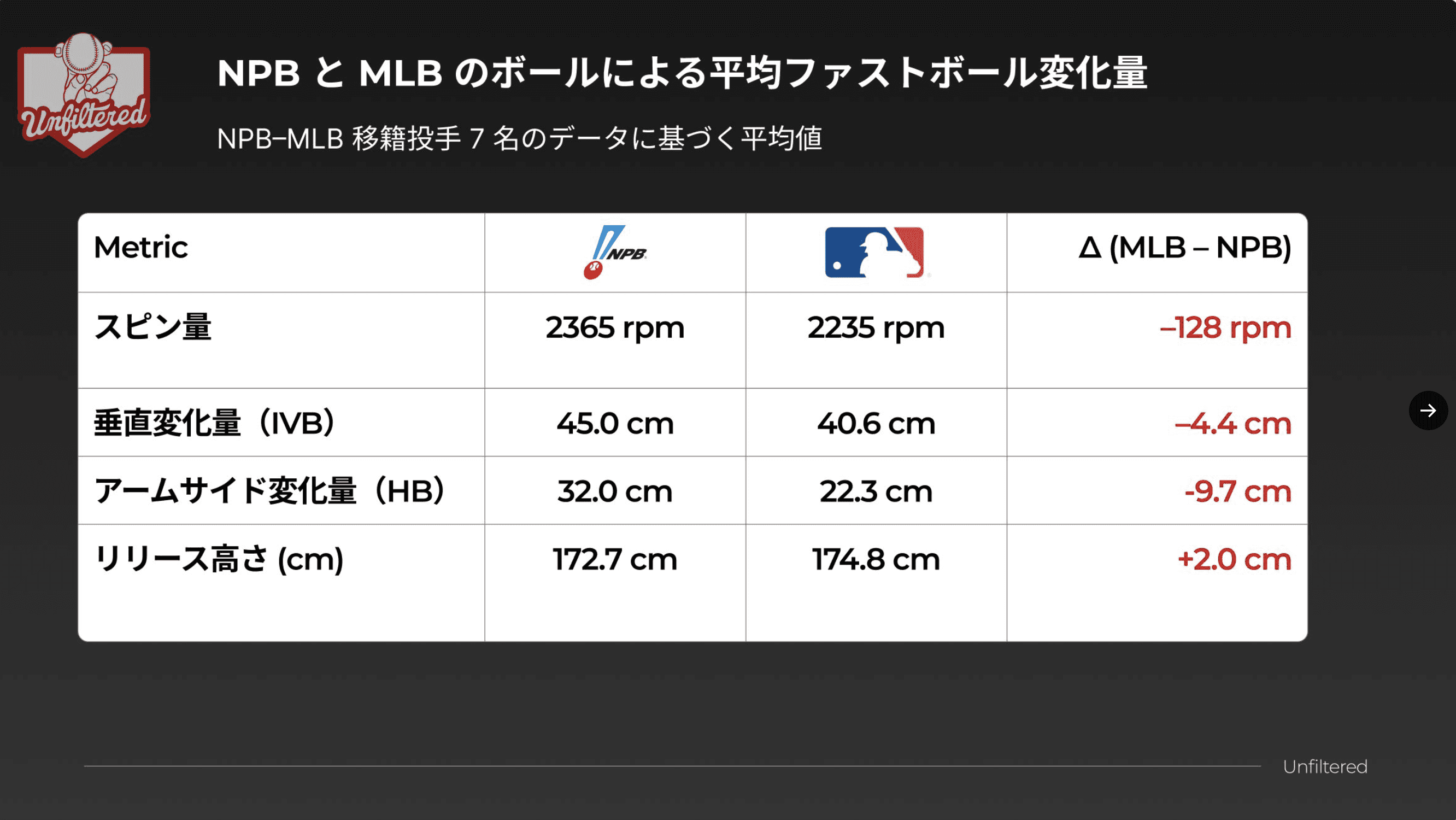
The MLB ball will reduce his four-seam metrics.
MLB Ball Impact & Grades

The MLB ball will reduce his four-seam metrics.

Expected losses: ~1.5-2.0" IVB, ~3" HB, ~100-150 rpm

Metric

NPB

MLB Projection

IVB

~13.5"

~12-13"

HB

~15"

~12"

Spin

2300 rpm

2150-2200 rpm

Grade buckets based on similar velocity/slot pitches in MLB:

IVB

Grade

SwStr%

11.5"

55-60

~11.5%

12.0"

60

~12.0%

12.5"

60-65

~12.5%

13.0"

60-65

~13.0%

13.5"

65

~13.5%

Based on typical VB variance (~1.65) across a year.

His NPB whiff rate of ~20%, combined with bat path differences and the fact that his zone locations in NPB were lower than they would be in MLB, suggests a 23-25% whiff projection is fair. A simple +7% boost (27%, Joe Ryan territory) seems aggressive, but the foundational mechanics support above-average outcomes.

Environment & The Platoon Problem

The environmental change matters for Imai's four-seam in multiple ways beyond just whiffs.


Metric

NPB Environment

MLB Environment

Notes

Upper-Third Called Strike % (taken, in-zone)

~65%

~75%

MLB rewards elevated heaters; NPB suppresses them

League-Average 4-Seam Whiff %

~14%

21%

MLB hitters swing under elevated FBs more frequently

NPB hitters whiff at four-seams 14% of the time. MLB hitters whiff 21%. Steeper bat paths, more undercut misses — his four-seam gains 7 points of whiff just from the league switch.

But here's what matters: his fastball command has an extreme platoon split.

vs RHH: 61% in-zone four-seams → 70% strike rate. He uses the glove-side plate width, and when he misses inside, the tail generates chase.

vs LHH: 63% in-zone four-seams → 66% strike rate. He's throwing MORE pitches in the zone to lefties, yet getting FEWER strike calls.

In 0-0 counts against left-handed hitters, Imai threw a higher percentage of pitches in the rulebook strike zone (62%) than he got strikes (60%).

That's almost impossible to do — but it's critical context for why the high strike call changes everything.

Why NPB Killed His Fastball

Overall VAA + Upper-Third Usage (the suppression)


Pitcher

Overall VAA

Upper-Third FB%

Called Strike % (Upper-Third In-Zone)

Joe Ryan

-3.85°

75%

79%

Luis Castillo

-4.0°

79%

76%

MLB Average

-4.7°

66%

75%

Tatsuya Imai

-4.2°

57%

53%

89 of Imai's 190 upper-third in-zone fastball takes in the NPB were called balls.

No pitcher had a worse called strike vs. zoned strike differential on their fastball over the last 3 years. This is an insane drop from the MLB experience pitching up.

Joe Ryan and Luis Castillo got those calls at a 76-80% clip!

The explanation:

NPB's zone limits the upper bounds of what a VAA-specific pitcher can accomplish by going up before 2 strikes. The reward structure doesn't exist. So he adapted — threw fewer fastballs up, which collapsed his VAA advantage.

This matters most against left-handed hitters.

VAA Before 2 Strikes by Batter Hand


Metric

VAA vs RHH (<2K)

VAA vs LHH (<2K)

Gap

MLB Average

-4.85°

-4.75°

+0.10°

Tatsuya Imai

-4.19°

-4.35°

-0.16°

The average MLB pitcher shifts up against lefties — VAA flattens by 0.10° because elevation is more common to the opposite hand. The vertical component of pitching is largely apples-to-apples regardless of handedness, whereas the horizontal component changes with angles and swing paths.

Imai shifted down. His VAA steepened by 0.16°. He threw 0.5 mph softer. Without early-count access to the upper part of the zone where he can progress the count, his VAA advantage — a vertical and velocity component independent of batter hand — collapsed against the split where he needed it most.

His four-seam shape is tail + elevation-first.

The tail is take/chase compatible against right-handed hitters, and that's where he squeezed value in NPB — glove-side command works, arm-side misses generate chase.

Against left-handed hitters, the tail reduces strike-stealing strategies outside of putting the ball firmly in the zone.

The pitch plays to both sides roughly equally in two locations: when elevated.

Imai didn't get this call in NPB.

Without exceptional command, and with a high-tailing four-seam, the natural spot to throw from his arm angle and get rewarded is up against lefties — but that pitch wasn't getting called a strike, and it didn't have the reward structure it would have in MLB.

There were no other routes for setting a walk floor against left-handed hitters.

Imai Fastball: Location+ & Pitch Value

Data from NPB Pitch Profile (via @bouno05):


Split

Location+ (2024-25 avg)

xPV/100 (2024-25 avg)

vs RHH

98

+0.55

vs LHH

78

-0.60

20-point Location+ gap. Positive pitch value to righties, negative to lefties.

This model (via @bouno05) is likely trained on NPB data and showcases how the location score based on plate locations was significantly worse to lefties compared to righties across the last 2 seasons — with pitch value per 100 being negative both years to lefties.

In my opinion, his fastball location penalty may be misaligned with NPB's zone preferences. In NPB, he has the outer edge and the tail for wild pitches in against righties — this may better explain where he was able to amplify NPB zone benefits. Whatever benefit he drew there can still be redistributed up in the zone in MLB.

But the real story is the gap vs LHH. He can use the outer edge more and has tail for righties, but this loses its use case against lefties where elevation is the primary action for count-moving utility.

The same pitch shape, thrown to the same spots, will grade out differently in a league that calls the upper-third strike.

The Importance of Getting the High Strike

In MLB, an upper-third in-zone four-seam that isn't swung at is called a strike 75% of the time. In NPB, it's just 65%.

I believe Imai got even less than 65% because he threw harder from a strange slot, it was more difficult for umpires to track, and there's cultural behavior bias toward calling more balls in a 65/35 league.

I'm not calling anyone out. I'm projecting the behavior of a human being behind the plate in a league that values keeping the ball down, facing 95+ mph from a strange slot, from a dominant and very difficult to hit pitcher, where the standard rate is 65/35 and these additional variables exist.

I'm not saying anyone did it intentionally, but in my opinion, there's no way Imai received the typical expected strikes against left-handed hitters relative to the league standard, and it's the only way to understand these results.

MLB umpires are evaluated by the rulebook zone only. I believe this will have a huge impact on his walk floor with his four-seam.

MLB Tailing Fastball Data: The Chase Gap

Here's how MLB four-seamers with >10" horizontal break perform before 2 strikes:


Split

Chase%

Strike%

In-Zone%

vs RHH

19.9%

68.1%

61.3%

vs LHH

14.7%

64.6%

59.7%

In MLB, the chase rate in early counts (~20%) for four-seamers with >10" HB helps explain the similar increase of ~7-10% in strike rate relative to zone rate that a pitcher like Imai will experience in both leagues when facing righties.

That same pitch to lefties has the chase rate suppressed greatly (14-15%) since it is rarely swung at when exiting the zone.

So much of the free strike gap on the widths of the plate make it where a power pitcher like Imai with tail on his fastball needs the upper-third portion of the zone called for him to not have a lighter strike-zone gap. Being in the strike zone, but being up and getting the calls (and inducing the swings) helps counter some of this — but explains why he may have struggled to see his strike rate even match his zone% vs LHH in early counts, especially if he was penalized beyond the 65% called rate experienced in the upper third of the zone with no swing.

The MLB Solution

In MLB, he may lose some edges against right-handed hitters, but he can go up to retain value floor and induce chase on inside misses.

Against left-handed hitters, he gains access to the one spot he should almost always throw to them: the upper third of the zone.

He soaks up the new reward structure that comes with it, which should favor a power-first four-seam profile with tail that needs the high strike to not have to pay for walk rate increases or major whiff/contact quality drops from being forced to throw down or in the middle.

His four-seam usage against lefties could go from 41% to 45-50%.

He may be the only NPB import who comes over and throws MORE four-seams. His four-seam was structurally suppressed in Japan.

This creates K↑ and BB↓ simultaneously against left-handed hitters — strikeout rate increases from the whiff environment, walk rate decreases from the strike environment.

The main addition: his overall strike rate before 2 strikes against lefties could increase 4-6 points (66% → 71%), and he can increase usage as well. Combine these utilities and it's a route to easing the walk floor concerns.

No other NPB starter benefits from both directions at once.

The fastball sets the floor. The slider determines the ceiling.

PART 2: THE SLIDER

Movement Profile & Outcomes

Imai's slider: 86 mph, ~1-2" vertical break, ~2-3" arm-side horizontal break.

Metric

Projected MLB Value

Notes

Slider Velocity

~86 mph

Typical velocity band for gyro-oriented MLB sliders

Slider Vertical Break

~1-2"

Gyro profile; consistent with depth-minded SL shapes

Slider Horizontal Break

~2-3+" arm-side

Semi-weird HB; shape uncommon across MLB

He appears to throw his slider with a grip more traditional for a sweeper, which likely leads to blended or strange seam orientation. When thrown without enough topspin (this grip combined with his high gyro metrics is rare), it fades back arm-side late.
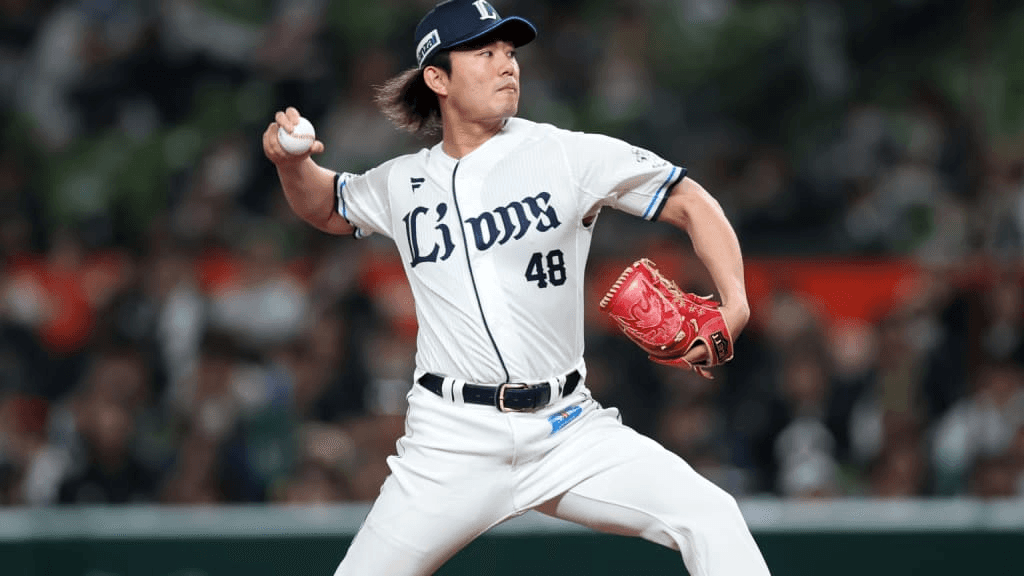
An example of a pitcher who has thrown something similar with success is Dinelson Lamet.

I don't know if this is a market inefficiency, but the ball flight metrics are similar to Griffin Canning and Bryce Elder — active examples of pitchers who regularly get this type of arm-side slider movement.

In MLB, similar pitch types generate a 20% swinging strike rate and 41% whiff rate against right-handed hitters.

Whether selection bias, uniquely difficult to throw, or something else — sliders regress to their outcomes far faster than fastballs. When weighting a pitch model, you should fit "how good is this pitch actually" to what hitters tell you with their swings much quicker for breaking balls than fastballs.

Imai pairs the upper bound of NPB slider whiffs with a 60-65 grade four-seam in an environment that rewards his fastball shape. Steeper MLB bat paths only add more whiff potential to both pitches.

Imai's NPB 2025 Slider Outcomes


Split

Whiff%

Pitches

vs RHH

53.2%

447

vs LHH

36.2%

391

Total

45.9%

838

838 total pitches, fully stabilized.

53% whiff against righties is 80-grade by outcome. Stuff+ models will likely grade this pitch in the 50-60 range due to average depth and average velocity.

Nothing in the modeling suggests this pitch should destroy right-handed hitters.

But it does.

Slider Comps: The Arm-Side Gyro


Type

SwStrk%

Miss%

Chase%

Strike%

In-Zone%

MLB RHP Slider Avg

15.7%

33.0%

31.3%

62.7%

45.4%

RHP Sliders <4" VB, >2" Arm-Side

19.8%

40.9%

31.6%

61.5%

42.6%

+4.1% SwStrk, +7.9% Miss vs league average slider.


Type

HB

VB

Velo

Arm-Side Gyro (Imai type)

+3.5"

0"

86 mph

Avg RHP Slider

-5" (sweep)

1.5"

86.1 mph

Top Pitchers in Usage (Last 3 Years):

Pitcher

SL Miss%

Pitches

D. Moreta (PIT)

41.1%

661

G. Canning (NYM)

47.0%

294

L. Jackson (SEA)

43.1%

193

B. Elder (ATL)

39.3%

161

L. Erceg (KC)

41.5%

97

H. Crouse (LAA)

44.2%

82

D. Cease (SD)

52.4%

45

This pitch type is rare, hard to throw, and generates elite whiffs. Imai's 53.2% whiff rate to RHH fits right in this bucket.

On The Rarity of This Slider Shape

There is reason to believe the ability to throw this slider may have teachable components, but the ability to induce reverse seam-shifted wake on a gyro ball that consistently moves to the arm side appears to potentially be rare given its performance.

Alternatively, the idea that the function of the pitch aligns more like a changeup (you don't want 2 pitches that fade right — you need something left) may suppress its volume. Either way, the shape is actually extremely platoon neutral while clearly having a massive whiff component to right-handed hitters across his NPB sample.

The pitch may have been suppressed to LHH even though the whiff (36%) relative to locations and CSW% (37%!) are still very good.

Translating to an environment in which:

  • Whiffs tend to go up

  • There is no platoon penalty for whiffs (rather all damage)

  • Strike creation is not penalized

...creates some upside for a pitcher whose main translation fear is a walk uptick and performance regression to Stuff+ metrics that align closer to the league average slider.

PART 3: THE RISE AND FALL OF BREAKING BALL STUFF+

2015: When Shape Variance Was Massive

In 2015, there was massive variance in slider shapes and outcomes.

45% of sliders thrown had <4" vertical break — they weren't sweepers, they were swing-and-miss gyros.

The other 55% averaged 86.2 mph with 8.5" vertical break. Closer to cutters than sliders — not swing-and-miss pitches, not gyros, not sweepers. Just middle-of-the-road breaking balls. And they weren't being thrown that hard.

The only pitchers who threw >300 modern swing-and-miss shapes:


Pitcher

Shape

Sliders

Result

Chris Archer

Gyro (<4" VB, lg-avg velo)

300+

252 strikeouts

Garrett Richards

Gyro (<4" VB, lg-avg velo)

300+

42% whiff

Gerrit Cole

Gyro (<4" VB, lg-avg velo)

300+

4th in Cy Young

Tyson Ross

Gyro (<4" VB, lg-avg velo)

300+

25% SwStr, 46% whiff, 2.98 FIP

Dallas Keuchel

Sweeper (>10" HB)

300+

Cy Young winner

Andrew Miller

Sweeper (>10" HB)

300+

229 K / 23 BB across '15/'16

Sergio Romo

Sweeper (>10" HB)

300+

1.90 FIP, 88 mph closer

Chris Sale

Sweeper (>10" HB)

300+

274 strikeouts

CC Sabathia

Sweeper (>10" HB)

300+

Future Hall of Famer

4 qualified starters threw gyros. 5 pitchers threw sweepers. That's it.

Breaking ball Stuff+ was wildly predictive when this was happening. Modern shapes were rare. Shape differentiated elite from average.

2015-2020, this trend maintained and it's why breaking ball Stuff+ was a jackpot. Most modern shapes can be reverse engineered from 2015-2020 shapes that worked. The delta in having ~0 vertical break and throwing firm, OR having >10" of sweep on your slider was a huge market inefficiency.

This trend maintained until 2021, blending to today's numbers mainly across the 2023-2025 seasons.

The ability to work off this at extreme margins was 2018-2022. The correction started in 2023 and sprinted in 2023-2024.

2023-2025 trained datasets are not showing the same marginal gap. Not even close.

2025: When Everyone Migrated to Optimal Buckets

Fast forward to today.

71% of right-handed pitcher sliders have <4" vertical break. The remaining 29% are thrown at 87.5 mph on average with 6.5" vertical break.

Nearly everyone is now binned into the "gyro" or "sweeper" bucket that drove the highest Stuff+ gains and were legitimate predictors in the pre-2022 trained dataset era.

Today, everyone is already in those buckets. Which means the ability to predict this pitch's output is nowhere near the equivalent delta it provided in 2020-2022 using trained data from previous years.

For breaking balls specifically, after simply controlling for how hard the pitcher throws, I purely and firmly believe predictive horsepower is near minimal / driving absolutely no predictive horsepower. The margins were in the past, and models can exist, but that doesn't mean it's driving the same delta or the correct solution for pitch projection in a different environment.

And this pitcher isn't throwing against high school hitters in the midwest or in a low-information environment — he's in a league where whiffs transfer.

Fastball Stuff+ has maintained. Because no one has found a way to train a 4-seam fastball. They have found ways to train breaking balls. But outside of velocity gains and acquisition-driven 4-seam fastball acquisition, the % of opportunities to amplify a pitcher's 4-seam fastball shape is extraordinarily rare.

That's why I constantly value fastballs specifically but differ greatly on breaking balls. And it's not because Stuff+ is good or bad — it's context and updating priors on trained datasets.

The Sweeper Correction

R-on-R Sweepers over time:


Year

Velo

HB

VB

Whiff%

xWOBA

2021

81.9

-14.4"

1.1"

39.3%

.226

2025

83.1

-14.7"

0.9"

33.1%

.262

The pitch got harder. The movement stayed the same. The whiff dropped 6.2%.

On Stabilization and the Asel Research

In 2021, John Asel (@johnnyasel) wrote an article for Driveline Baseball about how quickly breaking balls stabilize to their predicted outcomes relative to predicted run value expectations. It was 900 pitches.

The important thing to note is this was written in September 2021, and was trained off of Statcast-specific data (noted in the >3,000 leaders and laggards section) meaning it was looking at 2015-2021 data.

If it had breaking balls regressing back to 900 pitches to buy the outcomes in an era of far fewer gyro/sweeper buckets, how much quicker does Cronbach's alpha reach 0.7 in a 2023-2025 trained dataset filled with a mass bucket of <4" vert sliders and sweepers?

I'm not saying these are bad pitches — I'm saying the delta between the pitch value of those 2 buckets compared to the rest of the league's sliders has seen the juice get squeezed down since 2015-2021. Having those shapes no longer meaningfully moves the needle on projected performance like it used to.

Which means to me, the quality of the breaking ball is no longer meaningfully determined, especially for right-handed pitchers in the 94-to-96 mph fastball bucket, by Stuff+ or predicted run values in a way where the opportunity with Imai to hedge against models on his slider isn't rather large.

Prediction power here, after filtering out the pitcher's raw fastball velocity (which is stealing correlation and not insightful imo) — how much does Stuff+ of the breaking ball or intrinsic run values really provide?

It would seem there are better ways to quickly regress breaking balls on MiLB data (obviously not apples-to-apples, but it can't be 0) based on some form of launch angle / whiff correlator or something otherwise reliable but in a lower league talent level with strange behavior. There's at least functions of pitch outcomes you can capture, especially with Hawkeye bat pathing potentially detailing something in directional miss or distance of miss relative to location and typical swing miss at that location.

Taking quickly stabilizing outcomes (whiff, etc.) that correlate with run value in similar but not the same environment — e.g. partially blending even High-A whiffs relative to location to actual true talent projection, much less NPB data — must be applied even in low samples (>300 we start getting something).

Imai is over 2,500 sliders in the hardest league to generate strikeouts.

PART 4: NPB PLATOON PENALTY & TRANSLATION

The 6x Gap

The NPB platoon penalty is massive and underappreciated.

In MLB, reverse-platoon sliders (e.g., right-handed pitcher slider to left-handed hitter) have a 0.5% swinging strike rate gap compared to same-handed matchups. This is xISO driven — batted ball damage (+.070) but swinging strikes (-0.5%) and strikes in general (actually slightly better) remain near the same.

In NPB, that gap is 3%. 6x larger. And this is whiff driven.


League

Reverse-Platoon Gap

Driver

MLB

-0.5% SwStr

xISO (damage)

NPB

-3.0% SwStr

Whiff

NPB Slider Whiff Rates:


Split

Whiff%

R-on-R

31%

R-on-L

25%

In the zone, out of the zone — it's basically all across the data. Why it exists I don't have enough context of, but it is a real thing.

Imai threw 391 sliders to left-handed hitters in NPB and ate this penalty at extreme volume, which dragged his overall whiff rate down.

In MLB, this penalty normalizes. His slider whiff against lefties could recover toward 40% with 25% usage even in an action-induced role similar to Logan Gilbert / Max Meyer.

Cross-League Translation Data

Breaking ball whiff translation data for pitchers with 500+ breaking balls in both leagues:


Pitcher

MLB Whiff%

NPB Whiff%

Δ Whiff

Kodai Senga

34%

~26%

+8%

Yoshinobu Yamamoto

35%

~29%

+6%

Trevor Bauer

36%

~31%

+5%

Drew VerHagen

38%

~35%

+3%

Yuki Matsui

38%

~35%

+3%

Shota Imanaga

30%

~28%

+2%

Yusei Kikuchi

28%

~28%

0%

Tomoyuki Sugano

28%

~30%

-2%

On average, pitchers generate more whiffs on their breaking balls in MLB. High-whiff sliders improve or maintain. Imai sits in the elite-whiff bucket.

PART 5: THE SAMPLE MATTERS

2,000+ pitches of NPB hitters whiffing repeatedly at this slider is insanely more predictive than ball flight metrics in 2025.

Japanese hitters prioritize contact over damage — they're often trying to hit 500 foul balls, not 500 foot home runs.

Yes the leagues are different, yes MLB hitters are better on average, yes Imai will have huge changes to his damage profile naturally.

But I'm here to tell you if you can get Japanese hitters to miss the ball without even using a splitter or changeup that frequently, I am buying your whiffs being an apples-to-apples conversion, before even getting to the fastball environments helping him.

If you can generate 53% whiffs against righties with that approach, the pitch is legitimate.

Teams that anchor on Stuff+ will see near league-average Stuff+, and potentially near league-average predicted run values.

They should see a significant sample of whiffs to righties, the platoon effect to lefties, and a high called + swinging strike % of nearly 40% — and bring their model at minimum 2/3rds of the way towards those outcomes in weight of Stuff+/predicted run values.

These 2 things will drive $5-7M changes in teams' evaluation of Imai:

  1. The % merge in favor of Imai's NPB slider results vs. their stuff model.

  2. Their ability to contextualize and then lean on how the upper-third of the zone will help him throw more fastballs.

This helps contextualize crossover success when weighting last 3-year outcomes and his concerning walk rate in 2023-2024.

PART 6: PUTTING IT TOGETHER

The Scherzer Blueprint: Setting a Floor Against Lefties

Max Scherzer is one of the best pitchers of the last decade — a future first-ballot Hall of Famer with an unhittable right-on-right slider. His slider metrics were never particularly impressive.

Right-on-Right Slider Comparison:


Pitcher

League

Years

Sliders

Velo

VB

SwStr%

Whiff%

Max Scherzer

MLB

2015-2025

5,401

86

3.5"

26%

46%

Tatsuya Imai

NPB

2023-2025

1,022

86

2.5"

28%

53%

Scherzer's slider: 86 mph, 3.5" of vertical break. Imai's slider: 86 mph, 2.5" of vertical break with arm-side fade. Both sliders grade out as average-ish by Stuff+ metrics. Both sliders destroy right-handed hitters by outcome.

Max Scherzer 2015-2025 Splits


Split

PA

OPS

wOBA

vs RHH

3,343 (49%)

.548

.237

vs LHH

3,506 (51%)

.696

.301

League Average RHP Splits (approx):


Split

OPS

wOBA

vs RHH

~.700

~.305

vs LHH

~.750

~.325

  • Scherzer vs RHH: .548 OPS vs ~.700 league average → -152 OPS points (elite)

  • Scherzer vs LHH: .696 OPS vs ~.750 league average → -54 OPS points (above average/good)

Scherzer didn't need to dominate left-handed hitters. He managed them — staying above average — while being unhittable against righties. This allowed a tremendous amount of his surplus WAR and value to be soaked up by right-handed dominance while mitigating his floor against lefties.

I'm not saying Imai will be Scherzer. But his projected outcomes from NPB against right-handed hitters would seem to translate well enough that he can be the "average vs lefties, great vs righties" guy who quickly covers 3.5-4 WAR type seasons if he can just keep lefties contained with walks and/or damage.

The Path Forward

vs LHH: securing the walk rate is most critical and the adjustment is obvious. The 3-year models looking back on Imai will not like his walk rate concerns. Using the MLB environment and pitching accordingly, including higher fastball usage, is the bullish route for him and perhaps where he will deviate compared to other imports who relied more on the width of the plate for called strikes. Nonetheless, securing the strategy that sets him a floor is most critical.


LHB Performance Level

Projected MLB Performance

Explanation

Below Average

#3 Starter

RHB dominance carries WAR; LHB walks and/or extreme damage profile limit ceiling

MLB Average

#2 Starter (20-30 MLB)

Strikeout transferability vs RHB pushes WAR into 3-4+ range, 200-225 Strikeouts

Above Average

#1-2 Starter

Full ceiling unlocked

He has a changeup/splitter that performs well when ahead and functions well as a two-strike pitch to lefties. If he had to, he could go full Logan Gilbert / Max Meyer count-inducing sliders in the zone to lefties and still generate enough swing and miss and count progression that the splitter/vulcan value is real for pairing with this pitch and changing the role as needed.

The main wildcard is ultimately the HR rate. The ground ball rate was 50% but his isolated slugging was double against lefties compared to righties. While not an area to immediately address, it's hard to infer contact quality, but the way I would first pitch in style as Imai is as a pure peripheral chaser — securing the floor walk rate against lefties with fastballs and zoned sliders, knowing the outcomes of being a number 2 pitcher have a high likelihood of doing that given his historic ability to miss bats in the NPB.

There may be an adjustment later needed to stabilize his strategy, but there's no need to project that now, and there's no need to not start with simply chasing the strikeout-to-walk rate until the league forces you out of it when you have a history of walk issues — especially with a new environment to play with.

Modern Evaluation

This is what pitcher evaluation looks like in 2025.

Environment determines which metrics matter — his fastball was suppressed in NPB and will be amplified in MLB.

Outcomes matter and stabilize quickly relative to fastballs, especially since breaking balls post-sweeper-correction.

Structural edges (release height + velocity) can't be arbitraged like teachable skills (sweeper grips). Weird pitches (reverse sliders) may have some untrainable components, but the key detail is you buy slider whiff results in smaller samples... regressing your pitch model with the outcomes to blend.

Teams anchoring on Stuff+ or underweighting stabilized outcome samples will miss him. Everyone has variance and good/bad signings are often hindsight dictated, but the components of Imai in terms of translating him to the MLB zone, and his slider outcomes to LHH's are key areas of notes in which the ability to weight these things will result, in my opinion, in a large degree of potential separation.

I think hedging against breaking ball Stuff+ and having optimism on his fastball playing in a high zone league + the scarce entry of 95+ mph 5' release height starters provides an underpriced pitcher, with main risk being his overall command to left-handed hitters, and like any pitcher in existence, injuries.

Conclusion
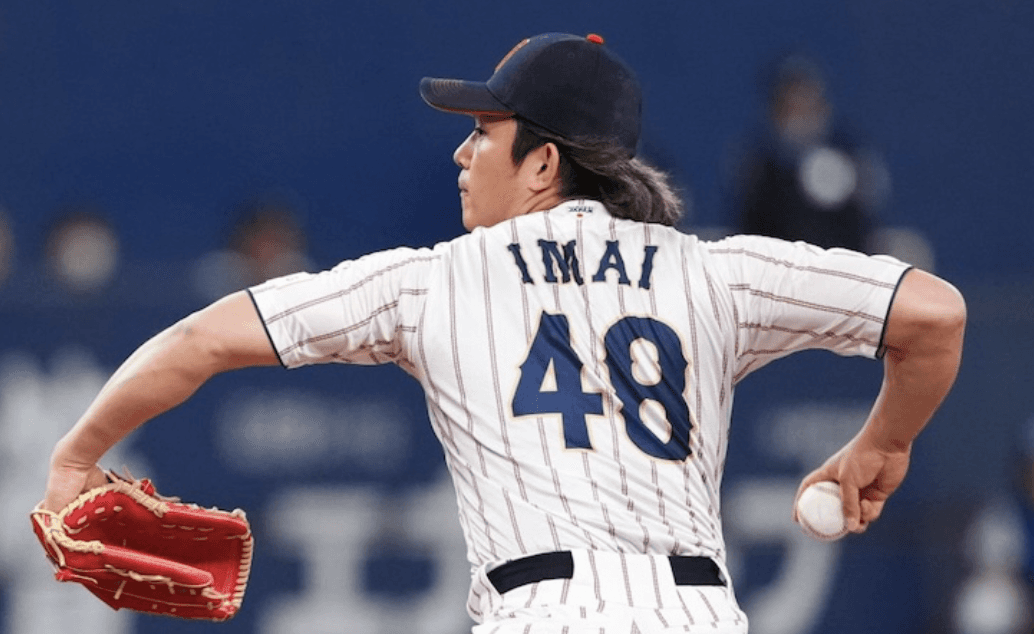
Tatsuya Imai is the inflection point for modern pitcher evaluation.

Not because he's the best pitcher in the world, but because how you evaluate him reveals whether you're updating your priors on:

  1. Breaking ball Stuff+ obsolescence (2023-2025 trained data)

  2. Structural vs trainable edges (release height vs sweeper grips)

  3. Outcome stabilization (2,500 pitches in a contact-first league)

  4. Maintaining firm on fastball Stuff+'s utility

  5. And your ability to interpret environmental translation (NPB zone behavior vs MLB)

Translating behavioral incentives — interpreting how a new environment changes a pitcher's usage, projecting new volume (more elevated fastballs), and forecasting outcomes when there is no real medium for an equivalent previous situation to this degree — is what will always drive long-term advantage in any market where previous margins from deltas in models are caught up on, whether in business or baseball. Pair that with updated priors to hedge for league trends and copycat tendencies when they inevitably and quickly fade.

I believe Tatsuya Imai deserves $200M+.

Credits & Data Sources

Word Count: ~6,500 | Read Time: ~25-30 minutes.

Introduction

Tatsuya Imai is the inflection point for modern pitcher evaluation.

This piece will cover:

  • Why NPB hitters whiffing repeatedly at his slider tells you more than Stuff+ will

  • Why the environmental change to a rewarded upper-third strike zone weighs heavily in his favor

  • And why these 2 things are the difference between a $25M AAV pitcher and a $32M AAV pitcher

On a 6-year deal, that's a $40M+ swing in total contract value.

I believe Tatsuya Imai deserves $200M+. Here's why.

PART 1: THE FASTBALL

The Profile


Metric

NPB Value

MLB Projection

IVB

~13.5"

~12-13"

HB

~15"

~12"

Spin

2300 rpm

2150-2200 rpm

This movement profile doesn't look good. Until you account for two things.

Tatsuya Imai throws 95 mph from a ~5'0" (152 cm) release point.

This combination is extraordinarily rare for a starting pitcher.

For reference: Joe Ryan has below-average vertical break on his four-seam and below-average velocity. Yet he leads the league in upper-third four-seam usage since 2015. He's only been pitching since 2020.

The Comps


Pitcher

Velocity

IVB

Release Height

Notes

Luis Castillo (SEA)

~95 mph

~12.5"

~5.0'

Premium comp; similar VB + slot + velocity band

Joe Ryan (MIN)

93-95 mph

~13.5"

~4.8'

Elite modern low-slot carry; high-end model

Tatsuya Imai

~95 mph

~12-13"

~5.0'

Same archetype. Can't be taught.

This is structural, not trainable. Which means it can't be mass-produced like sweeper grips. And sweepers saw their quality decline as quantity increased.

Spin Profile vs Notable NPB Arms


Pitcher

Spin Efficiency

Spin Rate

Back Spin

IVB

Imanaga

99%

2500

2000

18"

Sasaki

96%

2100

1400

14.5"

Imai

93-96%

2200

1050

12-13"

Yamamoto

91%

2200

1600

16"

Kikuchi

91%

2175

1500

15.5"

Senga

88%

2400

1700

16.5"

Ohtani

75%

2450

1500

14.5"

Imai's back spin (1050) is notably lower than his peers, but his release height and velocity combination give him a lower vertical approach angle than Shota Imanaga and his high spinning and high vertical break fastball.

Despite Imai having half the backspin as Imanaga, his additional 4 mph and 0.5 feet lower release height give him a flatter vertical approach angle.

Upper-Third Four-Seam Leaders

Since 2015, only 5 pitchers have thrown >2,500 four-seams from a release height under 63 inches:


Pitcher

First Full Season

Pitches

Joe Ryan

2022

3,095

Aaron Nola

2016

3,064

Andrew Heaney

2015

2,793

Craig Kimbrel

2011

2,734

Julio Teheran

2013

2,531

And since Joe Ryan entered the league (2022), the supply has plateaued:


Year

Pitches

% of 4-Seams

Velo

RelH

IVB

Miss%

SwStr%

xWOBA

2022

20,833

8.8%

92.9

4.82

13.1

24.5%

12.3%

.315

2023

24,421

10.6%

93.5

4.92

13.3

24.4%

12.4%

.325

2024

24,542

10.8%

93.4

4.93

12.8

23.5%

12.0%

.305

2025

23,912

10.6%

93.4

4.95

12.8

24.1%

12.4%

.316

Despite the demand for the outcomes, the supply has plateaued at ~10.5% of league four-seamers. You can't manufacture pitchers who throw this hard from this slot.

The league's average IVB in this bucket is actually declining (13.3" in 2023 → 12.8" in 2024-25), meaning teams are actively inputting pitchers into this sample who don't have elite carry — the demand for the geometry is higher than the supply of pitchers who can execute it with quality vertical break.

They're reaching for the slot because the outcomes justify it, even with below-average ride.

Why The Fastball Works: VAA Advantage

A low release point creates a flatter vertical approach angle (VAA).

MLB hitters swing at steep angles, trying to lift the ball. The flatter a four-seam comes in, the greater the mismatch between bat path and ball path.

This is why Joe Ryan's and Luis Castillo's four-seams work — the geometry forces a vertical mismatch that hitters can't adjust to mid-swing.

When you filter for pitchers at league-average release height, the correlation between vertical break and elite VAA is 0.66. Velocity is 0.45. The main mechanisms for improving VAA are more spin/spin efficiency and ride, or throwing harder.

But when you remove that filter — keeping even the middle 35-40% bucket of the population — the correlation between VAA and vertical break doesn't just drop, it becomes -0.3. Velocity has ZERO correlation.

The instant you throw from 5'0" or lower, you soak up massive value in driving the upper limits of this metric, and you have a high floor for whiffs regardless of how much carry you have.

The Logan Webb Example

Logan Webb averages just 10.5" VB on his four-seamer at around 93 mph.

He's a sinker-first pitcher that happens to possess a four-seamer without the usual traits (high spin, high efficiency, high velo) that normally allow for whiff potential with a heater.

He's able to maintain excellent contact suppression with ground balls and generate strikeouts depending on what the context calls for.

Not many pitchers can truly get the best of both worlds. And if they do it normally calls for plus-velocity and command or plus-plus velocity.

Webb is able to at 93 — 2 mph below the league average righty in fastball velocity — because the floor for whiffs at this release height is always there no matter the four-seam shape if you're over 92 mph.

VAA Comparison: Japanese MLB Arms & Primary Comps


Pitcher

Velo

Rel. Height

IVB

VAA

Starter Pctl

Grade

Jacob Misiorowski

99.2

5.26'

16.1"

-3.46°

99%

80

Joe Ryan

93.5

4.77'

13.7"

-3.53°

99%

80

Tatsuya Imai (Proj.)

95.0

5.00'

12.5"

-3.75°

95%

72

Yoshinobu Yamamoto

95.4

5.45'

16.0"

-3.85°

92%

69

Yusei Kikuchi

94.7

5.38'

15.5"

-3.90°

90%

67

Luis Castillo

95.0

5.17'

12.4"

-3.93°

89%

66

Shota Imanaga

90.8

5.45'

18.0"

-3.97°

87%

65

Shohei Ohtani

98.3

5.68'

14.7"

-4.07°

80%

61

Kodai Senga

94.7

5.93'

16.6"

-4.39°

51%

50

Roki Sasaki

95.8

6.13'

14.6"

-4.80°

16%

40

Imai projects as the third-flattest VAA among this group — trailing only Joe Ryan and Jacob Misiorowski among starting pitchers — despite having the lowest IVB in the entire comparison.

His release height + velocity combination does all the work.

Note that Misiorowski generates his elite VAA with both low slot AND elite velocity (99.2 mph). Imai achieves 95th percentile VAA with average-ish velocity (95 mph) purely through release geometry. This is the structural edge that can't be trained.

The Floor

Pitchers within this bucket still differentiate by how low they are, how much vertical break they have, and how hard they throw. But if Imai throws 95 mph from this release height and generates anywhere near 12 inches of vertical break, he has access to the region of the dataset where 70-grade achievers live just by throwing his four-seam.

He immediately enters 90th-95th percentile territory.

The fact that MLB hitters average 6'2" compared to NPB's 5'11" also gives Imai a small boost in strike probability, since the vertical zone is slightly taller.

As long as you throw hard and don't throw too many sinkers, the whiff floor is safe. More vertical carry from this slot enhances the upside, but the geometry already protects the baseline.

MLB Ball Impact & Grades

The MLB ball will reduce his four-seam metrics.

MLB Ball Impact & Grades

The MLB ball will reduce his four-seam metrics.

Expected losses: ~1.5-2.0" IVB, ~3" HB, ~100-150 rpm

Metric

NPB

MLB Projection

IVB

~13.5"

~12-13"

HB

~15"

~12"

Spin

2300 rpm

2150-2200 rpm

Grade buckets based on similar velocity/slot pitches in MLB:

IVB

Grade

SwStr%

11.5"

55-60

~11.5%

12.0"

60

~12.0%

12.5"

60-65

~12.5%

13.0"

60-65

~13.0%

13.5"

65

~13.5%

Based on typical VB variance (~1.65) across a year.

His NPB whiff rate of ~20%, combined with bat path differences and the fact that his zone locations in NPB were lower than they would be in MLB, suggests a 23-25% whiff projection is fair. A simple +7% boost (27%, Joe Ryan territory) seems aggressive, but the foundational mechanics support above-average outcomes.

Environment & The Platoon Problem

The environmental change matters for Imai's four-seam in multiple ways beyond just whiffs.


Metric

NPB Environment

MLB Environment

Notes

Upper-Third Called Strike % (taken, in-zone)

~65%

~75%

MLB rewards elevated heaters; NPB suppresses them

League-Average 4-Seam Whiff %

~14%

21%

MLB hitters swing under elevated FBs more frequently

NPB hitters whiff at four-seams 14% of the time. MLB hitters whiff 21%. Steeper bat paths, more undercut misses — his four-seam gains 7 points of whiff just from the league switch.

But here's what matters: his fastball command has an extreme platoon split.

vs RHH: 61% in-zone four-seams → 70% strike rate. He uses the glove-side plate width, and when he misses inside, the tail generates chase.

vs LHH: 63% in-zone four-seams → 66% strike rate. He's throwing MORE pitches in the zone to lefties, yet getting FEWER strike calls.

In 0-0 counts against left-handed hitters, Imai threw a higher percentage of pitches in the rulebook strike zone (62%) than he got strikes (60%).

That's almost impossible to do — but it's critical context for why the high strike call changes everything.

Why NPB Killed His Fastball

Overall VAA + Upper-Third Usage (the suppression)


Pitcher

Overall VAA

Upper-Third FB%

Called Strike % (Upper-Third In-Zone)

Joe Ryan

-3.85°

75%

79%

Luis Castillo

-4.0°

79%

76%

MLB Average

-4.7°

66%

75%

Tatsuya Imai

-4.2°

57%

53%

89 of Imai's 190 upper-third in-zone fastball takes in the NPB were called balls.

No pitcher had a worse called strike vs. zoned strike differential on their fastball over the last 3 years. This is an insane drop from the MLB experience pitching up.

Joe Ryan and Luis Castillo got those calls at a 76-80% clip!

The explanation:

NPB's zone limits the upper bounds of what a VAA-specific pitcher can accomplish by going up before 2 strikes. The reward structure doesn't exist. So he adapted — threw fewer fastballs up, which collapsed his VAA advantage.

This matters most against left-handed hitters.

VAA Before 2 Strikes by Batter Hand


Metric

VAA vs RHH (<2K)

VAA vs LHH (<2K)

Gap

MLB Average

-4.85°

-4.75°

+0.10°

Tatsuya Imai

-4.19°

-4.35°

-0.16°

The average MLB pitcher shifts up against lefties — VAA flattens by 0.10° because elevation is more common to the opposite hand. The vertical component of pitching is largely apples-to-apples regardless of handedness, whereas the horizontal component changes with angles and swing paths.

Imai shifted down. His VAA steepened by 0.16°. He threw 0.5 mph softer. Without early-count access to the upper part of the zone where he can progress the count, his VAA advantage — a vertical and velocity component independent of batter hand — collapsed against the split where he needed it most.

His four-seam shape is tail + elevation-first.

The tail is take/chase compatible against right-handed hitters, and that's where he squeezed value in NPB — glove-side command works, arm-side misses generate chase.

Against left-handed hitters, the tail reduces strike-stealing strategies outside of putting the ball firmly in the zone.

The pitch plays to both sides roughly equally in two locations: when elevated.

Imai didn't get this call in NPB.

Without exceptional command, and with a high-tailing four-seam, the natural spot to throw from his arm angle and get rewarded is up against lefties — but that pitch wasn't getting called a strike, and it didn't have the reward structure it would have in MLB.

There were no other routes for setting a walk floor against left-handed hitters.

Imai Fastball: Location+ & Pitch Value

Data from NPB Pitch Profile (via @bouno05):


Split

Location+ (2024-25 avg)

xPV/100 (2024-25 avg)

vs RHH

98

+0.55

vs LHH

78

-0.60

20-point Location+ gap. Positive pitch value to righties, negative to lefties.

This model (via @bouno05) is likely trained on NPB data and showcases how the location score based on plate locations was significantly worse to lefties compared to righties across the last 2 seasons — with pitch value per 100 being negative both years to lefties.

In my opinion, his fastball location penalty may be misaligned with NPB's zone preferences. In NPB, he has the outer edge and the tail for wild pitches in against righties — this may better explain where he was able to amplify NPB zone benefits. Whatever benefit he drew there can still be redistributed up in the zone in MLB.

But the real story is the gap vs LHH. He can use the outer edge more and has tail for righties, but this loses its use case against lefties where elevation is the primary action for count-moving utility.

The same pitch shape, thrown to the same spots, will grade out differently in a league that calls the upper-third strike.

The Importance of Getting the High Strike

In MLB, an upper-third in-zone four-seam that isn't swung at is called a strike 75% of the time. In NPB, it's just 65%.

I believe Imai got even less than 65% because he threw harder from a strange slot, it was more difficult for umpires to track, and there's cultural behavior bias toward calling more balls in a 65/35 league.

I'm not calling anyone out. I'm projecting the behavior of a human being behind the plate in a league that values keeping the ball down, facing 95+ mph from a strange slot, from a dominant and very difficult to hit pitcher, where the standard rate is 65/35 and these additional variables exist.

I'm not saying anyone did it intentionally, but in my opinion, there's no way Imai received the typical expected strikes against left-handed hitters relative to the league standard, and it's the only way to understand these results.

MLB umpires are evaluated by the rulebook zone only. I believe this will have a huge impact on his walk floor with his four-seam.

MLB Tailing Fastball Data: The Chase Gap

Here's how MLB four-seamers with >10" horizontal break perform before 2 strikes:


Split

Chase%

Strike%

In-Zone%

vs RHH

19.9%

68.1%

61.3%

vs LHH

14.7%

64.6%

59.7%

In MLB, the chase rate in early counts (~20%) for four-seamers with >10" HB helps explain the similar increase of ~7-10% in strike rate relative to zone rate that a pitcher like Imai will experience in both leagues when facing righties.

That same pitch to lefties has the chase rate suppressed greatly (14-15%) since it is rarely swung at when exiting the zone.

So much of the free strike gap on the widths of the plate make it where a power pitcher like Imai with tail on his fastball needs the upper-third portion of the zone called for him to not have a lighter strike-zone gap. Being in the strike zone, but being up and getting the calls (and inducing the swings) helps counter some of this — but explains why he may have struggled to see his strike rate even match his zone% vs LHH in early counts, especially if he was penalized beyond the 65% called rate experienced in the upper third of the zone with no swing.

The MLB Solution

In MLB, he may lose some edges against right-handed hitters, but he can go up to retain value floor and induce chase on inside misses.

Against left-handed hitters, he gains access to the one spot he should almost always throw to them: the upper third of the zone.

He soaks up the new reward structure that comes with it, which should favor a power-first four-seam profile with tail that needs the high strike to not have to pay for walk rate increases or major whiff/contact quality drops from being forced to throw down or in the middle.

His four-seam usage against lefties could go from 41% to 45-50%.

He may be the only NPB import who comes over and throws MORE four-seams. His four-seam was structurally suppressed in Japan.

This creates K↑ and BB↓ simultaneously against left-handed hitters — strikeout rate increases from the whiff environment, walk rate decreases from the strike environment.

The main addition: his overall strike rate before 2 strikes against lefties could increase 4-6 points (66% → 71%), and he can increase usage as well. Combine these utilities and it's a route to easing the walk floor concerns.

No other NPB starter benefits from both directions at once.

The fastball sets the floor. The slider determines the ceiling.

PART 2: THE SLIDER

Movement Profile & Outcomes

Imai's slider: 86 mph, ~1-2" vertical break, ~2-3" arm-side horizontal break.

Metric

Projected MLB Value

Notes

Slider Velocity

~86 mph

Typical velocity band for gyro-oriented MLB sliders

Slider Vertical Break

~1-2"

Gyro profile; consistent with depth-minded SL shapes

Slider Horizontal Break

~2-3+" arm-side

Semi-weird HB; shape uncommon across MLB

He appears to throw his slider with a grip more traditional for a sweeper, which likely leads to blended or strange seam orientation. When thrown without enough topspin (this grip combined with his high gyro metrics is rare), it fades back arm-side late.

An example of a pitcher who has thrown something similar with success is Dinelson Lamet.

I don't know if this is a market inefficiency, but the ball flight metrics are similar to Griffin Canning and Bryce Elder — active examples of pitchers who regularly get this type of arm-side slider movement.

In MLB, similar pitch types generate a 20% swinging strike rate and 41% whiff rate against right-handed hitters.

Whether selection bias, uniquely difficult to throw, or something else — sliders regress to their outcomes far faster than fastballs. When weighting a pitch model, you should fit "how good is this pitch actually" to what hitters tell you with their swings much quicker for breaking balls than fastballs.

Imai pairs the upper bound of NPB slider whiffs with a 60-65 grade four-seam in an environment that rewards his fastball shape. Steeper MLB bat paths only add more whiff potential to both pitches.

Imai's NPB 2025 Slider Outcomes


Split

Whiff%

Pitches

vs RHH

53.2%

447

vs LHH

36.2%

391

Total

45.9%

838

838 total pitches, fully stabilized.

53% whiff against righties is 80-grade by outcome. Stuff+ models will likely grade this pitch in the 50-60 range due to average depth and average velocity.

Nothing in the modeling suggests this pitch should destroy right-handed hitters.

But it does.

Slider Comps: The Arm-Side Gyro


Type

SwStrk%

Miss%

Chase%

Strike%

In-Zone%

MLB RHP Slider Avg

15.7%

33.0%

31.3%

62.7%

45.4%

RHP Sliders <4" VB, >2" Arm-Side

19.8%

40.9%

31.6%

61.5%

42.6%

+4.1% SwStrk, +7.9% Miss vs league average slider.


Type

HB

VB

Velo

Arm-Side Gyro (Imai type)

+3.5"

0"

86 mph

Avg RHP Slider

-5" (sweep)

1.5"

86.1 mph

Top Pitchers in Usage (Last 3 Years):

Pitcher

SL Miss%

Pitches

D. Moreta (PIT)

41.1%

661

G. Canning (NYM)

47.0%

294

L. Jackson (SEA)

43.1%

193

B. Elder (ATL)

39.3%

161

L. Erceg (KC)

41.5%

97

H. Crouse (LAA)

44.2%

82

D. Cease (SD)

52.4%

45

This pitch type is rare, hard to throw, and generates elite whiffs. Imai's 53.2% whiff rate to RHH fits right in this bucket.

On The Rarity of This Slider Shape

There is reason to believe the ability to throw this slider may have teachable components, but the ability to induce reverse seam-shifted wake on a gyro ball that consistently moves to the arm side appears to potentially be rare given its performance.

Alternatively, the idea that the function of the pitch aligns more like a changeup (you don't want 2 pitches that fade right — you need something left) may suppress its volume. Either way, the shape is actually extremely platoon neutral while clearly having a massive whiff component to right-handed hitters across his NPB sample.

The pitch may have been suppressed to LHH even though the whiff (36%) relative to locations and CSW% (37%!) are still very good.

Translating to an environment in which:

  • Whiffs tend to go up

  • There is no platoon penalty for whiffs (rather all damage)

  • Strike creation is not penalized

...creates some upside for a pitcher whose main translation fear is a walk uptick and performance regression to Stuff+ metrics that align closer to the league average slider.

PART 3: THE RISE AND FALL OF BREAKING BALL STUFF+

2015: When Shape Variance Was Massive

In 2015, there was massive variance in slider shapes and outcomes.

45% of sliders thrown had <4" vertical break — they weren't sweepers, they were swing-and-miss gyros.

The other 55% averaged 86.2 mph with 8.5" vertical break. Closer to cutters than sliders — not swing-and-miss pitches, not gyros, not sweepers. Just middle-of-the-road breaking balls. And they weren't being thrown that hard.

The only pitchers who threw >300 modern swing-and-miss shapes:


Pitcher

Shape

Sliders

Result

Chris Archer

Gyro (<4" VB, lg-avg velo)

300+

252 strikeouts

Garrett Richards

Gyro (<4" VB, lg-avg velo)

300+

42% whiff

Gerrit Cole

Gyro (<4" VB, lg-avg velo)

300+

4th in Cy Young

Tyson Ross

Gyro (<4" VB, lg-avg velo)

300+

25% SwStr, 46% whiff, 2.98 FIP

Dallas Keuchel

Sweeper (>10" HB)

300+

Cy Young winner

Andrew Miller

Sweeper (>10" HB)

300+

229 K / 23 BB across '15/'16

Sergio Romo

Sweeper (>10" HB)

300+

1.90 FIP, 88 mph closer

Chris Sale

Sweeper (>10" HB)

300+

274 strikeouts

CC Sabathia

Sweeper (>10" HB)

300+

Future Hall of Famer

4 qualified starters threw gyros. 5 pitchers threw sweepers. That's it.

Breaking ball Stuff+ was wildly predictive when this was happening. Modern shapes were rare. Shape differentiated elite from average.

2015-2020, this trend maintained and it's why breaking ball Stuff+ was a jackpot. Most modern shapes can be reverse engineered from 2015-2020 shapes that worked. The delta in having ~0 vertical break and throwing firm, OR having >10" of sweep on your slider was a huge market inefficiency.

This trend maintained until 2021, blending to today's numbers mainly across the 2023-2025 seasons.

The ability to work off this at extreme margins was 2018-2022. The correction started in 2023 and sprinted in 2023-2024.

2023-2025 trained datasets are not showing the same marginal gap. Not even close.

2025: When Everyone Migrated to Optimal Buckets

Fast forward to today.

71% of right-handed pitcher sliders have <4" vertical break. The remaining 29% are thrown at 87.5 mph on average with 6.5" vertical break.

Nearly everyone is now binned into the "gyro" or "sweeper" bucket that drove the highest Stuff+ gains and were legitimate predictors in the pre-2022 trained dataset era.

Today, everyone is already in those buckets. Which means the ability to predict this pitch's output is nowhere near the equivalent delta it provided in 2020-2022 using trained data from previous years.

For breaking balls specifically, after simply controlling for how hard the pitcher throws, I purely and firmly believe predictive horsepower is near minimal / driving absolutely no predictive horsepower. The margins were in the past, and models can exist, but that doesn't mean it's driving the same delta or the correct solution for pitch projection in a different environment.

And this pitcher isn't throwing against high school hitters in the midwest or in a low-information environment — he's in a league where whiffs transfer.

Fastball Stuff+ has maintained. Because no one has found a way to train a 4-seam fastball. They have found ways to train breaking balls. But outside of velocity gains and acquisition-driven 4-seam fastball acquisition, the % of opportunities to amplify a pitcher's 4-seam fastball shape is extraordinarily rare.

That's why I constantly value fastballs specifically but differ greatly on breaking balls. And it's not because Stuff+ is good or bad — it's context and updating priors on trained datasets.

The Sweeper Correction

R-on-R Sweepers over time:


Year

Velo

HB

VB

Whiff%

xWOBA

2021

81.9

-14.4"

1.1"

39.3%

.226

2025

83.1

-14.7"

0.9"

33.1%

.262

The pitch got harder. The movement stayed the same. The whiff dropped 6.2%.

On Stabilization and the Asel Research

In 2021, John Asel (@johnnyasel) wrote an article for Driveline Baseball about how quickly breaking balls stabilize to their predicted outcomes relative to predicted run value expectations. It was 900 pitches.

The important thing to note is this was written in September 2021, and was trained off of Statcast-specific data (noted in the >3,000 leaders and laggards section) meaning it was looking at 2015-2021 data.

If it had breaking balls regressing back to 900 pitches to buy the outcomes in an era of far fewer gyro/sweeper buckets, how much quicker does Cronbach's alpha reach 0.7 in a 2023-2025 trained dataset filled with a mass bucket of <4" vert sliders and sweepers?

I'm not saying these are bad pitches — I'm saying the delta between the pitch value of those 2 buckets compared to the rest of the league's sliders has seen the juice get squeezed down since 2015-2021. Having those shapes no longer meaningfully moves the needle on projected performance like it used to.

Which means to me, the quality of the breaking ball is no longer meaningfully determined, especially for right-handed pitchers in the 94-to-96 mph fastball bucket, by Stuff+ or predicted run values in a way where the opportunity with Imai to hedge against models on his slider isn't rather large.

Prediction power here, after filtering out the pitcher's raw fastball velocity (which is stealing correlation and not insightful imo) — how much does Stuff+ of the breaking ball or intrinsic run values really provide?

It would seem there are better ways to quickly regress breaking balls on MiLB data (obviously not apples-to-apples, but it can't be 0) based on some form of launch angle / whiff correlator or something otherwise reliable but in a lower league talent level with strange behavior. There's at least functions of pitch outcomes you can capture, especially with Hawkeye bat pathing potentially detailing something in directional miss or distance of miss relative to location and typical swing miss at that location.

Taking quickly stabilizing outcomes (whiff, etc.) that correlate with run value in similar but not the same environment — e.g. partially blending even High-A whiffs relative to location to actual true talent projection, much less NPB data — must be applied even in low samples (>300 we start getting something).

Imai is over 2,500 sliders in the hardest league to generate strikeouts.

PART 4: NPB PLATOON PENALTY & TRANSLATION

The 6x Gap

The NPB platoon penalty is massive and underappreciated.

In MLB, reverse-platoon sliders (e.g., right-handed pitcher slider to left-handed hitter) have a 0.5% swinging strike rate gap compared to same-handed matchups. This is xISO driven — batted ball damage (+.070) but swinging strikes (-0.5%) and strikes in general (actually slightly better) remain near the same.

In NPB, that gap is 3%. 6x larger. And this is whiff driven.


League

Reverse-Platoon Gap

Driver

MLB

-0.5% SwStr

xISO (damage)

NPB

-3.0% SwStr

Whiff

NPB Slider Whiff Rates:


Split

Whiff%

R-on-R

31%

R-on-L

25%

In the zone, out of the zone — it's basically all across the data. Why it exists I don't have enough context of, but it is a real thing.

Imai threw 391 sliders to left-handed hitters in NPB and ate this penalty at extreme volume, which dragged his overall whiff rate down.

In MLB, this penalty normalizes. His slider whiff against lefties could recover toward 40% with 25% usage even in an action-induced role similar to Logan Gilbert / Max Meyer.

Cross-League Translation Data

Breaking ball whiff translation data for pitchers with 500+ breaking balls in both leagues:


Pitcher

MLB Whiff%

NPB Whiff%

Δ Whiff

Kodai Senga

34%

~26%

+8%

Yoshinobu Yamamoto

35%

~29%

+6%

Trevor Bauer

36%

~31%

+5%

Drew VerHagen

38%

~35%

+3%

Yuki Matsui

38%

~35%

+3%

Shota Imanaga

30%

~28%

+2%

Yusei Kikuchi

28%

~28%

0%

Tomoyuki Sugano

28%

~30%

-2%

On average, pitchers generate more whiffs on their breaking balls in MLB. High-whiff sliders improve or maintain. Imai sits in the elite-whiff bucket.

PART 5: THE SAMPLE MATTERS

2,000+ pitches of NPB hitters whiffing repeatedly at this slider is insanely more predictive than ball flight metrics in 2025.

Japanese hitters prioritize contact over damage — they're often trying to hit 500 foul balls, not 500 foot home runs.

Yes the leagues are different, yes MLB hitters are better on average, yes Imai will have huge changes to his damage profile naturally.

But I'm here to tell you if you can get Japanese hitters to miss the ball without even using a splitter or changeup that frequently, I am buying your whiffs being an apples-to-apples conversion, before even getting to the fastball environments helping him.

If you can generate 53% whiffs against righties with that approach, the pitch is legitimate.

Teams that anchor on Stuff+ will see near league-average Stuff+, and potentially near league-average predicted run values.

They should see a significant sample of whiffs to righties, the platoon effect to lefties, and a high called + swinging strike % of nearly 40% — and bring their model at minimum 2/3rds of the way towards those outcomes in weight of Stuff+/predicted run values.

These 2 things will drive $5-7M changes in teams' evaluation of Imai:

  1. The % merge in favor of Imai's NPB slider results vs. their stuff model.

  2. Their ability to contextualize and then lean on how the upper-third of the zone will help him throw more fastballs.

This helps contextualize crossover success when weighting last 3-year outcomes and his concerning walk rate in 2023-2024.

PART 6: PUTTING IT TOGETHER

The Scherzer Blueprint: Setting a Floor Against Lefties

Max Scherzer is one of the best pitchers of the last decade — a future first-ballot Hall of Famer with an unhittable right-on-right slider. His slider metrics were never particularly impressive.

Right-on-Right Slider Comparison:


Pitcher

League

Years

Sliders

Velo

VB

SwStr%

Whiff%

Max Scherzer

MLB

2015-2025

5,401

86

3.5"

26%

46%

Tatsuya Imai

NPB

2023-2025

1,022

86

2.5"

28%

53%

Scherzer's slider: 86 mph, 3.5" of vertical break. Imai's slider: 86 mph, 2.5" of vertical break with arm-side fade. Both sliders grade out as average-ish by Stuff+ metrics. Both sliders destroy right-handed hitters by outcome.

Max Scherzer 2015-2025 Splits


Split

PA

OPS

wOBA

vs RHH

3,343 (49%)

.548

.237

vs LHH

3,506 (51%)

.696

.301

League Average RHP Splits (approx):


Split

OPS

wOBA

vs RHH

~.700

~.305

vs LHH

~.750

~.325

  • Scherzer vs RHH: .548 OPS vs ~.700 league average → -152 OPS points (elite)

  • Scherzer vs LHH: .696 OPS vs ~.750 league average → -54 OPS points (above average/good)

Scherzer didn't need to dominate left-handed hitters. He managed them — staying above average — while being unhittable against righties. This allowed a tremendous amount of his surplus WAR and value to be soaked up by right-handed dominance while mitigating his floor against lefties.

I'm not saying Imai will be Scherzer. But his projected outcomes from NPB against right-handed hitters would seem to translate well enough that he can be the "average vs lefties, great vs righties" guy who quickly covers 3.5-4 WAR type seasons if he can just keep lefties contained with walks and/or damage.

The Path Forward

vs LHH: securing the walk rate is most critical and the adjustment is obvious. The 3-year models looking back on Imai will not like his walk rate concerns. Using the MLB environment and pitching accordingly, including higher fastball usage, is the bullish route for him and perhaps where he will deviate compared to other imports who relied more on the width of the plate for called strikes. Nonetheless, securing the strategy that sets him a floor is most critical.


LHB Performance Level

Projected MLB Performance

Explanation

Below Average

#3 Starter

RHB dominance carries WAR; LHB walks and/or extreme damage profile limit ceiling

MLB Average

#2 Starter (20-30 MLB)

Strikeout transferability vs RHB pushes WAR into 3-4+ range, 200-225 Strikeouts

Above Average

#1-2 Starter

Full ceiling unlocked

He has a changeup/splitter that performs well when ahead and functions well as a two-strike pitch to lefties. If he had to, he could go full Logan Gilbert / Max Meyer count-inducing sliders in the zone to lefties and still generate enough swing and miss and count progression that the splitter/vulcan value is real for pairing with this pitch and changing the role as needed.

The main wildcard is ultimately the HR rate. The ground ball rate was 50% but his isolated slugging was double against lefties compared to righties. While not an area to immediately address, it's hard to infer contact quality, but the way I would first pitch in style as Imai is as a pure peripheral chaser — securing the floor walk rate against lefties with fastballs and zoned sliders, knowing the outcomes of being a number 2 pitcher have a high likelihood of doing that given his historic ability to miss bats in the NPB.

There may be an adjustment later needed to stabilize his strategy, but there's no need to project that now, and there's no need to not start with simply chasing the strikeout-to-walk rate until the league forces you out of it when you have a history of walk issues — especially with a new environment to play with.

Modern Evaluation

This is what pitcher evaluation looks like in 2025.

Environment determines which metrics matter — his fastball was suppressed in NPB and will be amplified in MLB.

Outcomes matter and stabilize quickly relative to fastballs, especially since breaking balls post-sweeper-correction.

Structural edges (release height + velocity) can't be arbitraged like teachable skills (sweeper grips). Weird pitches (reverse sliders) may have some untrainable components, but the key detail is you buy slider whiff results in smaller samples... regressing your pitch model with the outcomes to blend.

Teams anchoring on Stuff+ or underweighting stabilized outcome samples will miss him. Everyone has variance and good/bad signings are often hindsight dictated, but the components of Imai in terms of translating him to the MLB zone, and his slider outcomes to LHH's are key areas of notes in which the ability to weight these things will result, in my opinion, in a large degree of potential separation.

I think hedging against breaking ball Stuff+ and having optimism on his fastball playing in a high zone league + the scarce entry of 95+ mph 5' release height starters provides an underpriced pitcher, with main risk being his overall command to left-handed hitters, and like any pitcher in existence, injuries.

Conclusion

Tatsuya Imai is the inflection point for modern pitcher evaluation.

Not because he's the best pitcher in the world, but because how you evaluate him reveals whether you're updating your priors on:

  1. Breaking ball Stuff+ obsolescence (2023-2025 trained data)

  2. Structural vs trainable edges (release height vs sweeper grips)

  3. Outcome stabilization (2,500 pitches in a contact-first league)

  4. Maintaining firm on fastball Stuff+'s utility

  5. And your ability to interpret environmental translation (NPB zone behavior vs MLB)

Translating behavioral incentives — interpreting how a new environment changes a pitcher's usage, projecting new volume (more elevated fastballs), and forecasting outcomes when there is no real medium for an equivalent previous situation to this degree — is what will always drive long-term advantage in any market where previous margins from deltas in models are caught up on, whether in business or baseball. Pair that with updated priors to hedge for league trends and copycat tendencies when they inevitably and quickly fade.

I believe Tatsuya Imai deserves $200M+.

Credits & Data Sources

Word Count: ~6,500 | Read Time: ~25-30 minutes.

Introduction

Tatsuya Imai is the inflection point for modern pitcher evaluation.

This piece will cover:

  • Why NPB hitters whiffing repeatedly at his slider tells you more than Stuff+ will

  • Why the environmental change to a rewarded upper-third strike zone weighs heavily in his favor

  • And why these 2 things are the difference between a $25M AAV pitcher and a $32M AAV pitcher

On a 6-year deal, that's a $40M+ swing in total contract value.

I believe Tatsuya Imai deserves $200M+. Here's why.

PART 1: THE FASTBALL

The Profile


Metric

NPB Value

MLB Projection

IVB

~13.5"

~12-13"

HB

~15"

~12"

Spin

2300 rpm

2150-2200 rpm

This movement profile doesn't look good. Until you account for two things.

Tatsuya Imai throws 95 mph from a ~5'0" (152 cm) release point.

This combination is extraordinarily rare for a starting pitcher.

For reference: Joe Ryan has below-average vertical break on his four-seam and below-average velocity. Yet he leads the league in upper-third four-seam usage since 2015. He's only been pitching since 2020.

The Comps


Pitcher

Velocity

IVB

Release Height

Notes

Luis Castillo (SEA)

~95 mph

~12.5"

~5.0'

Premium comp; similar VB + slot + velocity band

Joe Ryan (MIN)

93-95 mph

~13.5"

~4.8'

Elite modern low-slot carry; high-end model

Tatsuya Imai

~95 mph

~12-13"

~5.0'

Same archetype. Can't be taught.

This is structural, not trainable. Which means it can't be mass-produced like sweeper grips. And sweepers saw their quality decline as quantity increased.

Spin Profile vs Notable NPB Arms


Pitcher

Spin Efficiency

Spin Rate

Back Spin

IVB

Imanaga

99%

2500

2000

18"

Sasaki

96%

2100

1400

14.5"

Imai

93-96%

2200

1050

12-13"

Yamamoto

91%

2200

1600

16"

Kikuchi

91%

2175

1500

15.5"

Senga

88%

2400

1700

16.5"

Ohtani

75%

2450

1500

14.5"

Imai's back spin (1050) is notably lower than his peers, but his release height and velocity combination give him a lower vertical approach angle than Shota Imanaga and his high spinning and high vertical break fastball.

Despite Imai having half the backspin as Imanaga, his additional 4 mph and 0.5 feet lower release height give him a flatter vertical approach angle.

Upper-Third Four-Seam Leaders

Since 2015, only 5 pitchers have thrown >2,500 four-seams from a release height under 63 inches:


Pitcher

First Full Season

Pitches

Joe Ryan

2022

3,095

Aaron Nola

2016

3,064

Andrew Heaney

2015

2,793

Craig Kimbrel

2011

2,734

Julio Teheran

2013

2,531

And since Joe Ryan entered the league (2022), the supply has plateaued:


Year

Pitches

% of 4-Seams

Velo

RelH

IVB

Miss%

SwStr%

xWOBA

2022

20,833

8.8%

92.9

4.82

13.1

24.5%

12.3%

.315

2023

24,421

10.6%

93.5

4.92

13.3

24.4%

12.4%

.325

2024

24,542

10.8%

93.4

4.93

12.8

23.5%

12.0%

.305

2025

23,912

10.6%

93.4

4.95

12.8

24.1%

12.4%

.316

Despite the demand for the outcomes, the supply has plateaued at ~10.5% of league four-seamers. You can't manufacture pitchers who throw this hard from this slot.

The league's average IVB in this bucket is actually declining (13.3" in 2023 → 12.8" in 2024-25), meaning teams are actively inputting pitchers into this sample who don't have elite carry — the demand for the geometry is higher than the supply of pitchers who can execute it with quality vertical break.

They're reaching for the slot because the outcomes justify it, even with below-average ride.

Why The Fastball Works: VAA Advantage

A low release point creates a flatter vertical approach angle (VAA).

MLB hitters swing at steep angles, trying to lift the ball. The flatter a four-seam comes in, the greater the mismatch between bat path and ball path.

This is why Joe Ryan's and Luis Castillo's four-seams work — the geometry forces a vertical mismatch that hitters can't adjust to mid-swing.

When you filter for pitchers at league-average release height, the correlation between vertical break and elite VAA is 0.66. Velocity is 0.45. The main mechanisms for improving VAA are more spin/spin efficiency and ride, or throwing harder.

But when you remove that filter — keeping even the middle 35-40% bucket of the population — the correlation between VAA and vertical break doesn't just drop, it becomes -0.3. Velocity has ZERO correlation.

The instant you throw from 5'0" or lower, you soak up massive value in driving the upper limits of this metric, and you have a high floor for whiffs regardless of how much carry you have.

The Logan Webb Example

Logan Webb averages just 10.5" VB on his four-seamer at around 93 mph.

He's a sinker-first pitcher that happens to possess a four-seamer without the usual traits (high spin, high efficiency, high velo) that normally allow for whiff potential with a heater.

He's able to maintain excellent contact suppression with ground balls and generate strikeouts depending on what the context calls for.

Not many pitchers can truly get the best of both worlds. And if they do it normally calls for plus-velocity and command or plus-plus velocity.

Webb is able to at 93 — 2 mph below the league average righty in fastball velocity — because the floor for whiffs at this release height is always there no matter the four-seam shape if you're over 92 mph.

VAA Comparison: Japanese MLB Arms & Primary Comps


Pitcher

Velo

Rel. Height

IVB

VAA

Starter Pctl

Grade

Jacob Misiorowski

99.2

5.26'

16.1"

-3.46°

99%

80

Joe Ryan

93.5

4.77'

13.7"

-3.53°

99%

80

Tatsuya Imai (Proj.)

95.0

5.00'

12.5"

-3.75°

95%

72

Yoshinobu Yamamoto

95.4

5.45'

16.0"

-3.85°

92%

69

Yusei Kikuchi

94.7

5.38'

15.5"

-3.90°

90%

67

Luis Castillo

95.0

5.17'

12.4"

-3.93°

89%

66

Shota Imanaga

90.8

5.45'

18.0"

-3.97°

87%

65

Shohei Ohtani

98.3

5.68'

14.7"

-4.07°

80%

61

Kodai Senga

94.7

5.93'

16.6"

-4.39°

51%

50

Roki Sasaki

95.8

6.13'

14.6"

-4.80°

16%

40

Imai projects as the third-flattest VAA among this group — trailing only Joe Ryan and Jacob Misiorowski among starting pitchers — despite having the lowest IVB in the entire comparison.

His release height + velocity combination does all the work.

Note that Misiorowski generates his elite VAA with both low slot AND elite velocity (99.2 mph). Imai achieves 95th percentile VAA with average-ish velocity (95 mph) purely through release geometry. This is the structural edge that can't be trained.

The Floor

Pitchers within this bucket still differentiate by how low they are, how much vertical break they have, and how hard they throw. But if Imai throws 95 mph from this release height and generates anywhere near 12 inches of vertical break, he has access to the region of the dataset where 70-grade achievers live just by throwing his four-seam.

He immediately enters 90th-95th percentile territory.

The fact that MLB hitters average 6'2" compared to NPB's 5'11" also gives Imai a small boost in strike probability, since the vertical zone is slightly taller.

As long as you throw hard and don't throw too many sinkers, the whiff floor is safe. More vertical carry from this slot enhances the upside, but the geometry already protects the baseline.

MLB Ball Impact & Grades

The MLB ball will reduce his four-seam metrics.

MLB Ball Impact & Grades

The MLB ball will reduce his four-seam metrics.

Expected losses: ~1.5-2.0" IVB, ~3" HB, ~100-150 rpm

Metric

NPB

MLB Projection

IVB

~13.5"

~12-13"

HB

~15"

~12"

Spin

2300 rpm

2150-2200 rpm

Grade buckets based on similar velocity/slot pitches in MLB:

IVB

Grade

SwStr%

11.5"

55-60

~11.5%

12.0"

60

~12.0%

12.5"

60-65

~12.5%

13.0"

60-65

~13.0%

13.5"

65

~13.5%

Based on typical VB variance (~1.65) across a year.

His NPB whiff rate of ~20%, combined with bat path differences and the fact that his zone locations in NPB were lower than they would be in MLB, suggests a 23-25% whiff projection is fair. A simple +7% boost (27%, Joe Ryan territory) seems aggressive, but the foundational mechanics support above-average outcomes.

Environment & The Platoon Problem

The environmental change matters for Imai's four-seam in multiple ways beyond just whiffs.


Metric

NPB Environment

MLB Environment

Notes

Upper-Third Called Strike % (taken, in-zone)

~65%

~75%

MLB rewards elevated heaters; NPB suppresses them

League-Average 4-Seam Whiff %

~14%

21%

MLB hitters swing under elevated FBs more frequently

NPB hitters whiff at four-seams 14% of the time. MLB hitters whiff 21%. Steeper bat paths, more undercut misses — his four-seam gains 7 points of whiff just from the league switch.

But here's what matters: his fastball command has an extreme platoon split.

vs RHH: 61% in-zone four-seams → 70% strike rate. He uses the glove-side plate width, and when he misses inside, the tail generates chase.

vs LHH: 63% in-zone four-seams → 66% strike rate. He's throwing MORE pitches in the zone to lefties, yet getting FEWER strike calls.

In 0-0 counts against left-handed hitters, Imai threw a higher percentage of pitches in the rulebook strike zone (62%) than he got strikes (60%).

That's almost impossible to do — but it's critical context for why the high strike call changes everything.

Why NPB Killed His Fastball

Overall VAA + Upper-Third Usage (the suppression)


Pitcher

Overall VAA

Upper-Third FB%

Called Strike % (Upper-Third In-Zone)

Joe Ryan

-3.85°

75%

79%

Luis Castillo

-4.0°

79%

76%

MLB Average

-4.7°

66%

75%

Tatsuya Imai

-4.2°

57%

53%

89 of Imai's 190 upper-third in-zone fastball takes in the NPB were called balls.

No pitcher had a worse called strike vs. zoned strike differential on their fastball over the last 3 years. This is an insane drop from the MLB experience pitching up.

Joe Ryan and Luis Castillo got those calls at a 76-80% clip!

The explanation:

NPB's zone limits the upper bounds of what a VAA-specific pitcher can accomplish by going up before 2 strikes. The reward structure doesn't exist. So he adapted — threw fewer fastballs up, which collapsed his VAA advantage.

This matters most against left-handed hitters.

VAA Before 2 Strikes by Batter Hand


Metric

VAA vs RHH (<2K)

VAA vs LHH (<2K)

Gap

MLB Average

-4.85°

-4.75°

+0.10°

Tatsuya Imai

-4.19°

-4.35°

-0.16°

The average MLB pitcher shifts up against lefties — VAA flattens by 0.10° because elevation is more common to the opposite hand. The vertical component of pitching is largely apples-to-apples regardless of handedness, whereas the horizontal component changes with angles and swing paths.

Imai shifted down. His VAA steepened by 0.16°. He threw 0.5 mph softer. Without early-count access to the upper part of the zone where he can progress the count, his VAA advantage — a vertical and velocity component independent of batter hand — collapsed against the split where he needed it most.

His four-seam shape is tail + elevation-first.

The tail is take/chase compatible against right-handed hitters, and that's where he squeezed value in NPB — glove-side command works, arm-side misses generate chase.

Against left-handed hitters, the tail reduces strike-stealing strategies outside of putting the ball firmly in the zone.

The pitch plays to both sides roughly equally in two locations: when elevated.

Imai didn't get this call in NPB.

Without exceptional command, and with a high-tailing four-seam, the natural spot to throw from his arm angle and get rewarded is up against lefties — but that pitch wasn't getting called a strike, and it didn't have the reward structure it would have in MLB.

There were no other routes for setting a walk floor against left-handed hitters.

Imai Fastball: Location+ & Pitch Value

Data from NPB Pitch Profile (via @bouno05):


Split

Location+ (2024-25 avg)

xPV/100 (2024-25 avg)

vs RHH

98

+0.55

vs LHH

78

-0.60

20-point Location+ gap. Positive pitch value to righties, negative to lefties.

This model (via @bouno05) is likely trained on NPB data and showcases how the location score based on plate locations was significantly worse to lefties compared to righties across the last 2 seasons — with pitch value per 100 being negative both years to lefties.

In my opinion, his fastball location penalty may be misaligned with NPB's zone preferences. In NPB, he has the outer edge and the tail for wild pitches in against righties — this may better explain where he was able to amplify NPB zone benefits. Whatever benefit he drew there can still be redistributed up in the zone in MLB.

But the real story is the gap vs LHH. He can use the outer edge more and has tail for righties, but this loses its use case against lefties where elevation is the primary action for count-moving utility.

The same pitch shape, thrown to the same spots, will grade out differently in a league that calls the upper-third strike.

The Importance of Getting the High Strike

In MLB, an upper-third in-zone four-seam that isn't swung at is called a strike 75% of the time. In NPB, it's just 65%.

I believe Imai got even less than 65% because he threw harder from a strange slot, it was more difficult for umpires to track, and there's cultural behavior bias toward calling more balls in a 65/35 league.

I'm not calling anyone out. I'm projecting the behavior of a human being behind the plate in a league that values keeping the ball down, facing 95+ mph from a strange slot, from a dominant and very difficult to hit pitcher, where the standard rate is 65/35 and these additional variables exist.

I'm not saying anyone did it intentionally, but in my opinion, there's no way Imai received the typical expected strikes against left-handed hitters relative to the league standard, and it's the only way to understand these results.

MLB umpires are evaluated by the rulebook zone only. I believe this will have a huge impact on his walk floor with his four-seam.

MLB Tailing Fastball Data: The Chase Gap

Here's how MLB four-seamers with >10" horizontal break perform before 2 strikes:


Split

Chase%

Strike%

In-Zone%

vs RHH

19.9%

68.1%

61.3%

vs LHH

14.7%

64.6%

59.7%

In MLB, the chase rate in early counts (~20%) for four-seamers with >10" HB helps explain the similar increase of ~7-10% in strike rate relative to zone rate that a pitcher like Imai will experience in both leagues when facing righties.

That same pitch to lefties has the chase rate suppressed greatly (14-15%) since it is rarely swung at when exiting the zone.

So much of the free strike gap on the widths of the plate make it where a power pitcher like Imai with tail on his fastball needs the upper-third portion of the zone called for him to not have a lighter strike-zone gap. Being in the strike zone, but being up and getting the calls (and inducing the swings) helps counter some of this — but explains why he may have struggled to see his strike rate even match his zone% vs LHH in early counts, especially if he was penalized beyond the 65% called rate experienced in the upper third of the zone with no swing.

The MLB Solution

In MLB, he may lose some edges against right-handed hitters, but he can go up to retain value floor and induce chase on inside misses.

Against left-handed hitters, he gains access to the one spot he should almost always throw to them: the upper third of the zone.

He soaks up the new reward structure that comes with it, which should favor a power-first four-seam profile with tail that needs the high strike to not have to pay for walk rate increases or major whiff/contact quality drops from being forced to throw down or in the middle.

His four-seam usage against lefties could go from 41% to 45-50%.

He may be the only NPB import who comes over and throws MORE four-seams. His four-seam was structurally suppressed in Japan.

This creates K↑ and BB↓ simultaneously against left-handed hitters — strikeout rate increases from the whiff environment, walk rate decreases from the strike environment.

The main addition: his overall strike rate before 2 strikes against lefties could increase 4-6 points (66% → 71%), and he can increase usage as well. Combine these utilities and it's a route to easing the walk floor concerns.

No other NPB starter benefits from both directions at once.

The fastball sets the floor. The slider determines the ceiling.

PART 2: THE SLIDER

Movement Profile & Outcomes

Imai's slider: 86 mph, ~1-2" vertical break, ~2-3" arm-side horizontal break.

Metric

Projected MLB Value

Notes

Slider Velocity

~86 mph

Typical velocity band for gyro-oriented MLB sliders

Slider Vertical Break

~1-2"

Gyro profile; consistent with depth-minded SL shapes

Slider Horizontal Break

~2-3+" arm-side

Semi-weird HB; shape uncommon across MLB

He appears to throw his slider with a grip more traditional for a sweeper, which likely leads to blended or strange seam orientation. When thrown without enough topspin (this grip combined with his high gyro metrics is rare), it fades back arm-side late.

An example of a pitcher who has thrown something similar with success is Dinelson Lamet.

I don't know if this is a market inefficiency, but the ball flight metrics are similar to Griffin Canning and Bryce Elder — active examples of pitchers who regularly get this type of arm-side slider movement.

In MLB, similar pitch types generate a 20% swinging strike rate and 41% whiff rate against right-handed hitters.

Whether selection bias, uniquely difficult to throw, or something else — sliders regress to their outcomes far faster than fastballs. When weighting a pitch model, you should fit "how good is this pitch actually" to what hitters tell you with their swings much quicker for breaking balls than fastballs.

Imai pairs the upper bound of NPB slider whiffs with a 60-65 grade four-seam in an environment that rewards his fastball shape. Steeper MLB bat paths only add more whiff potential to both pitches.

Imai's NPB 2025 Slider Outcomes


Split

Whiff%

Pitches

vs RHH

53.2%

447

vs LHH

36.2%

391

Total

45.9%

838

838 total pitches, fully stabilized.

53% whiff against righties is 80-grade by outcome. Stuff+ models will likely grade this pitch in the 50-60 range due to average depth and average velocity.

Nothing in the modeling suggests this pitch should destroy right-handed hitters.

But it does.

Slider Comps: The Arm-Side Gyro


Type

SwStrk%

Miss%

Chase%

Strike%

In-Zone%

MLB RHP Slider Avg

15.7%

33.0%

31.3%

62.7%

45.4%

RHP Sliders <4" VB, >2" Arm-Side

19.8%

40.9%

31.6%

61.5%

42.6%

+4.1% SwStrk, +7.9% Miss vs league average slider.


Type

HB

VB

Velo

Arm-Side Gyro (Imai type)

+3.5"

0"

86 mph

Avg RHP Slider

-5" (sweep)

1.5"

86.1 mph

Top Pitchers in Usage (Last 3 Years):

Pitcher

SL Miss%

Pitches

D. Moreta (PIT)

41.1%

661

G. Canning (NYM)

47.0%

294

L. Jackson (SEA)

43.1%

193

B. Elder (ATL)

39.3%

161

L. Erceg (KC)

41.5%

97

H. Crouse (LAA)

44.2%

82

D. Cease (SD)

52.4%

45

This pitch type is rare, hard to throw, and generates elite whiffs. Imai's 53.2% whiff rate to RHH fits right in this bucket.

On The Rarity of This Slider Shape

There is reason to believe the ability to throw this slider may have teachable components, but the ability to induce reverse seam-shifted wake on a gyro ball that consistently moves to the arm side appears to potentially be rare given its performance.

Alternatively, the idea that the function of the pitch aligns more like a changeup (you don't want 2 pitches that fade right — you need something left) may suppress its volume. Either way, the shape is actually extremely platoon neutral while clearly having a massive whiff component to right-handed hitters across his NPB sample.

The pitch may have been suppressed to LHH even though the whiff (36%) relative to locations and CSW% (37%!) are still very good.

Translating to an environment in which:

  • Whiffs tend to go up

  • There is no platoon penalty for whiffs (rather all damage)

  • Strike creation is not penalized

...creates some upside for a pitcher whose main translation fear is a walk uptick and performance regression to Stuff+ metrics that align closer to the league average slider.

PART 3: THE RISE AND FALL OF BREAKING BALL STUFF+

2015: When Shape Variance Was Massive

In 2015, there was massive variance in slider shapes and outcomes.

45% of sliders thrown had <4" vertical break — they weren't sweepers, they were swing-and-miss gyros.

The other 55% averaged 86.2 mph with 8.5" vertical break. Closer to cutters than sliders — not swing-and-miss pitches, not gyros, not sweepers. Just middle-of-the-road breaking balls. And they weren't being thrown that hard.

The only pitchers who threw >300 modern swing-and-miss shapes:


Pitcher

Shape

Sliders

Result

Chris Archer

Gyro (<4" VB, lg-avg velo)

300+

252 strikeouts

Garrett Richards

Gyro (<4" VB, lg-avg velo)

300+

42% whiff

Gerrit Cole

Gyro (<4" VB, lg-avg velo)

300+

4th in Cy Young

Tyson Ross

Gyro (<4" VB, lg-avg velo)

300+

25% SwStr, 46% whiff, 2.98 FIP

Dallas Keuchel

Sweeper (>10" HB)

300+

Cy Young winner

Andrew Miller

Sweeper (>10" HB)

300+

229 K / 23 BB across '15/'16

Sergio Romo

Sweeper (>10" HB)

300+

1.90 FIP, 88 mph closer

Chris Sale

Sweeper (>10" HB)

300+

274 strikeouts

CC Sabathia

Sweeper (>10" HB)

300+

Future Hall of Famer

4 qualified starters threw gyros. 5 pitchers threw sweepers. That's it.

Breaking ball Stuff+ was wildly predictive when this was happening. Modern shapes were rare. Shape differentiated elite from average.

2015-2020, this trend maintained and it's why breaking ball Stuff+ was a jackpot. Most modern shapes can be reverse engineered from 2015-2020 shapes that worked. The delta in having ~0 vertical break and throwing firm, OR having >10" of sweep on your slider was a huge market inefficiency.

This trend maintained until 2021, blending to today's numbers mainly across the 2023-2025 seasons.

The ability to work off this at extreme margins was 2018-2022. The correction started in 2023 and sprinted in 2023-2024.

2023-2025 trained datasets are not showing the same marginal gap. Not even close.

2025: When Everyone Migrated to Optimal Buckets

Fast forward to today.

71% of right-handed pitcher sliders have <4" vertical break. The remaining 29% are thrown at 87.5 mph on average with 6.5" vertical break.

Nearly everyone is now binned into the "gyro" or "sweeper" bucket that drove the highest Stuff+ gains and were legitimate predictors in the pre-2022 trained dataset era.

Today, everyone is already in those buckets. Which means the ability to predict this pitch's output is nowhere near the equivalent delta it provided in 2020-2022 using trained data from previous years.

For breaking balls specifically, after simply controlling for how hard the pitcher throws, I purely and firmly believe predictive horsepower is near minimal / driving absolutely no predictive horsepower. The margins were in the past, and models can exist, but that doesn't mean it's driving the same delta or the correct solution for pitch projection in a different environment.

And this pitcher isn't throwing against high school hitters in the midwest or in a low-information environment — he's in a league where whiffs transfer.

Fastball Stuff+ has maintained. Because no one has found a way to train a 4-seam fastball. They have found ways to train breaking balls. But outside of velocity gains and acquisition-driven 4-seam fastball acquisition, the % of opportunities to amplify a pitcher's 4-seam fastball shape is extraordinarily rare.

That's why I constantly value fastballs specifically but differ greatly on breaking balls. And it's not because Stuff+ is good or bad — it's context and updating priors on trained datasets.

The Sweeper Correction

R-on-R Sweepers over time:


Year

Velo

HB

VB

Whiff%

xWOBA

2021

81.9

-14.4"

1.1"

39.3%

.226

2025

83.1

-14.7"

0.9"

33.1%

.262

The pitch got harder. The movement stayed the same. The whiff dropped 6.2%.

On Stabilization and the Asel Research

In 2021, John Asel (@johnnyasel) wrote an article for Driveline Baseball about how quickly breaking balls stabilize to their predicted outcomes relative to predicted run value expectations. It was 900 pitches.

The important thing to note is this was written in September 2021, and was trained off of Statcast-specific data (noted in the >3,000 leaders and laggards section) meaning it was looking at 2015-2021 data.

If it had breaking balls regressing back to 900 pitches to buy the outcomes in an era of far fewer gyro/sweeper buckets, how much quicker does Cronbach's alpha reach 0.7 in a 2023-2025 trained dataset filled with a mass bucket of <4" vert sliders and sweepers?

I'm not saying these are bad pitches — I'm saying the delta between the pitch value of those 2 buckets compared to the rest of the league's sliders has seen the juice get squeezed down since 2015-2021. Having those shapes no longer meaningfully moves the needle on projected performance like it used to.

Which means to me, the quality of the breaking ball is no longer meaningfully determined, especially for right-handed pitchers in the 94-to-96 mph fastball bucket, by Stuff+ or predicted run values in a way where the opportunity with Imai to hedge against models on his slider isn't rather large.

Prediction power here, after filtering out the pitcher's raw fastball velocity (which is stealing correlation and not insightful imo) — how much does Stuff+ of the breaking ball or intrinsic run values really provide?

It would seem there are better ways to quickly regress breaking balls on MiLB data (obviously not apples-to-apples, but it can't be 0) based on some form of launch angle / whiff correlator or something otherwise reliable but in a lower league talent level with strange behavior. There's at least functions of pitch outcomes you can capture, especially with Hawkeye bat pathing potentially detailing something in directional miss or distance of miss relative to location and typical swing miss at that location.

Taking quickly stabilizing outcomes (whiff, etc.) that correlate with run value in similar but not the same environment — e.g. partially blending even High-A whiffs relative to location to actual true talent projection, much less NPB data — must be applied even in low samples (>300 we start getting something).

Imai is over 2,500 sliders in the hardest league to generate strikeouts.

PART 4: NPB PLATOON PENALTY & TRANSLATION

The 6x Gap

The NPB platoon penalty is massive and underappreciated.

In MLB, reverse-platoon sliders (e.g., right-handed pitcher slider to left-handed hitter) have a 0.5% swinging strike rate gap compared to same-handed matchups. This is xISO driven — batted ball damage (+.070) but swinging strikes (-0.5%) and strikes in general (actually slightly better) remain near the same.

In NPB, that gap is 3%. 6x larger. And this is whiff driven.


League

Reverse-Platoon Gap

Driver

MLB

-0.5% SwStr

xISO (damage)

NPB

-3.0% SwStr

Whiff

NPB Slider Whiff Rates:


Split

Whiff%

R-on-R

31%

R-on-L

25%

In the zone, out of the zone — it's basically all across the data. Why it exists I don't have enough context of, but it is a real thing.

Imai threw 391 sliders to left-handed hitters in NPB and ate this penalty at extreme volume, which dragged his overall whiff rate down.

In MLB, this penalty normalizes. His slider whiff against lefties could recover toward 40% with 25% usage even in an action-induced role similar to Logan Gilbert / Max Meyer.

Cross-League Translation Data

Breaking ball whiff translation data for pitchers with 500+ breaking balls in both leagues:


Pitcher

MLB Whiff%

NPB Whiff%

Δ Whiff

Kodai Senga

34%

~26%

+8%

Yoshinobu Yamamoto

35%

~29%

+6%

Trevor Bauer

36%

~31%

+5%

Drew VerHagen

38%

~35%

+3%

Yuki Matsui

38%

~35%

+3%

Shota Imanaga

30%

~28%

+2%

Yusei Kikuchi

28%

~28%

0%

Tomoyuki Sugano

28%

~30%

-2%

On average, pitchers generate more whiffs on their breaking balls in MLB. High-whiff sliders improve or maintain. Imai sits in the elite-whiff bucket.

PART 5: THE SAMPLE MATTERS

2,000+ pitches of NPB hitters whiffing repeatedly at this slider is insanely more predictive than ball flight metrics in 2025.

Japanese hitters prioritize contact over damage — they're often trying to hit 500 foul balls, not 500 foot home runs.

Yes the leagues are different, yes MLB hitters are better on average, yes Imai will have huge changes to his damage profile naturally.

But I'm here to tell you if you can get Japanese hitters to miss the ball without even using a splitter or changeup that frequently, I am buying your whiffs being an apples-to-apples conversion, before even getting to the fastball environments helping him.

If you can generate 53% whiffs against righties with that approach, the pitch is legitimate.

Teams that anchor on Stuff+ will see near league-average Stuff+, and potentially near league-average predicted run values.

They should see a significant sample of whiffs to righties, the platoon effect to lefties, and a high called + swinging strike % of nearly 40% — and bring their model at minimum 2/3rds of the way towards those outcomes in weight of Stuff+/predicted run values.

These 2 things will drive $5-7M changes in teams' evaluation of Imai:

  1. The % merge in favor of Imai's NPB slider results vs. their stuff model.

  2. Their ability to contextualize and then lean on how the upper-third of the zone will help him throw more fastballs.

This helps contextualize crossover success when weighting last 3-year outcomes and his concerning walk rate in 2023-2024.

PART 6: PUTTING IT TOGETHER

The Scherzer Blueprint: Setting a Floor Against Lefties

Max Scherzer is one of the best pitchers of the last decade — a future first-ballot Hall of Famer with an unhittable right-on-right slider. His slider metrics were never particularly impressive.

Right-on-Right Slider Comparison:


Pitcher

League

Years

Sliders

Velo

VB

SwStr%

Whiff%

Max Scherzer

MLB

2015-2025

5,401

86

3.5"

26%

46%

Tatsuya Imai

NPB

2023-2025

1,022

86

2.5"

28%

53%

Scherzer's slider: 86 mph, 3.5" of vertical break. Imai's slider: 86 mph, 2.5" of vertical break with arm-side fade. Both sliders grade out as average-ish by Stuff+ metrics. Both sliders destroy right-handed hitters by outcome.

Max Scherzer 2015-2025 Splits


Split

PA

OPS

wOBA

vs RHH

3,343 (49%)

.548

.237

vs LHH

3,506 (51%)

.696

.301

League Average RHP Splits (approx):


Split

OPS

wOBA

vs RHH

~.700

~.305

vs LHH

~.750

~.325

  • Scherzer vs RHH: .548 OPS vs ~.700 league average → -152 OPS points (elite)

  • Scherzer vs LHH: .696 OPS vs ~.750 league average → -54 OPS points (above average/good)

Scherzer didn't need to dominate left-handed hitters. He managed them — staying above average — while being unhittable against righties. This allowed a tremendous amount of his surplus WAR and value to be soaked up by right-handed dominance while mitigating his floor against lefties.

I'm not saying Imai will be Scherzer. But his projected outcomes from NPB against right-handed hitters would seem to translate well enough that he can be the "average vs lefties, great vs righties" guy who quickly covers 3.5-4 WAR type seasons if he can just keep lefties contained with walks and/or damage.

The Path Forward

vs LHH: securing the walk rate is most critical and the adjustment is obvious. The 3-year models looking back on Imai will not like his walk rate concerns. Using the MLB environment and pitching accordingly, including higher fastball usage, is the bullish route for him and perhaps where he will deviate compared to other imports who relied more on the width of the plate for called strikes. Nonetheless, securing the strategy that sets him a floor is most critical.


LHB Performance Level

Projected MLB Performance

Explanation

Below Average

#3 Starter

RHB dominance carries WAR; LHB walks and/or extreme damage profile limit ceiling

MLB Average

#2 Starter (20-30 MLB)

Strikeout transferability vs RHB pushes WAR into 3-4+ range, 200-225 Strikeouts

Above Average

#1-2 Starter

Full ceiling unlocked

He has a changeup/splitter that performs well when ahead and functions well as a two-strike pitch to lefties. If he had to, he could go full Logan Gilbert / Max Meyer count-inducing sliders in the zone to lefties and still generate enough swing and miss and count progression that the splitter/vulcan value is real for pairing with this pitch and changing the role as needed.

The main wildcard is ultimately the HR rate. The ground ball rate was 50% but his isolated slugging was double against lefties compared to righties. While not an area to immediately address, it's hard to infer contact quality, but the way I would first pitch in style as Imai is as a pure peripheral chaser — securing the floor walk rate against lefties with fastballs and zoned sliders, knowing the outcomes of being a number 2 pitcher have a high likelihood of doing that given his historic ability to miss bats in the NPB.

There may be an adjustment later needed to stabilize his strategy, but there's no need to project that now, and there's no need to not start with simply chasing the strikeout-to-walk rate until the league forces you out of it when you have a history of walk issues — especially with a new environment to play with.

Modern Evaluation

This is what pitcher evaluation looks like in 2025.

Environment determines which metrics matter — his fastball was suppressed in NPB and will be amplified in MLB.

Outcomes matter and stabilize quickly relative to fastballs, especially since breaking balls post-sweeper-correction.

Structural edges (release height + velocity) can't be arbitraged like teachable skills (sweeper grips). Weird pitches (reverse sliders) may have some untrainable components, but the key detail is you buy slider whiff results in smaller samples... regressing your pitch model with the outcomes to blend.

Teams anchoring on Stuff+ or underweighting stabilized outcome samples will miss him. Everyone has variance and good/bad signings are often hindsight dictated, but the components of Imai in terms of translating him to the MLB zone, and his slider outcomes to LHH's are key areas of notes in which the ability to weight these things will result, in my opinion, in a large degree of potential separation.

I think hedging against breaking ball Stuff+ and having optimism on his fastball playing in a high zone league + the scarce entry of 95+ mph 5' release height starters provides an underpriced pitcher, with main risk being his overall command to left-handed hitters, and like any pitcher in existence, injuries.

Conclusion

Tatsuya Imai is the inflection point for modern pitcher evaluation.

Not because he's the best pitcher in the world, but because how you evaluate him reveals whether you're updating your priors on:

  1. Breaking ball Stuff+ obsolescence (2023-2025 trained data)

  2. Structural vs trainable edges (release height vs sweeper grips)

  3. Outcome stabilization (2,500 pitches in a contact-first league)

  4. Maintaining firm on fastball Stuff+'s utility

  5. And your ability to interpret environmental translation (NPB zone behavior vs MLB)

Translating behavioral incentives — interpreting how a new environment changes a pitcher's usage, projecting new volume (more elevated fastballs), and forecasting outcomes when there is no real medium for an equivalent previous situation to this degree — is what will always drive long-term advantage in any market where previous margins from deltas in models are caught up on, whether in business or baseball. Pair that with updated priors to hedge for league trends and copycat tendencies when they inevitably and quickly fade.

I believe Tatsuya Imai deserves $200M+.

Credits & Data Sources

Word Count: ~6,500 | Read Time: ~25-30 minutes.

Ready to scale your brand to new heights?

If you want to achieve ground-breaking growth with increased sales and profitability with paid ads, then you're in the right place.

Ready to see if this
is for You?

Reach out directly to Chris at chris@unfilteredlabs.com for a free consultation. #Unfiltered #AuthenticDevelopment #PitchingExcellence

Ready to see if this
is for You?

Reach out directly to Chris at chris@unfilteredlabs.com for a free consultation. #Unfiltered #AuthenticDevelopment #PitchingExcellence

Ready to see if this
is for You?

Reach out directly to Chris at chris@unfilteredlabs.com for a free consultation. #Unfiltered #AuthenticDevelopment #PitchingExcellence

Copyright © 2025 Unfiltered Labs

Copyright © 2025 Unfiltered Labs

Copyright © 2025 Unfiltered Labs