Written by
Chris Langin
8 min read
PART 1: THE START
Kona Takahashi averaged 93 mph last season. Two years of results that never quite matched what the velocity suggested they should be. Strikeouts were never the calling card they should have been for a pitcher with his stuff.
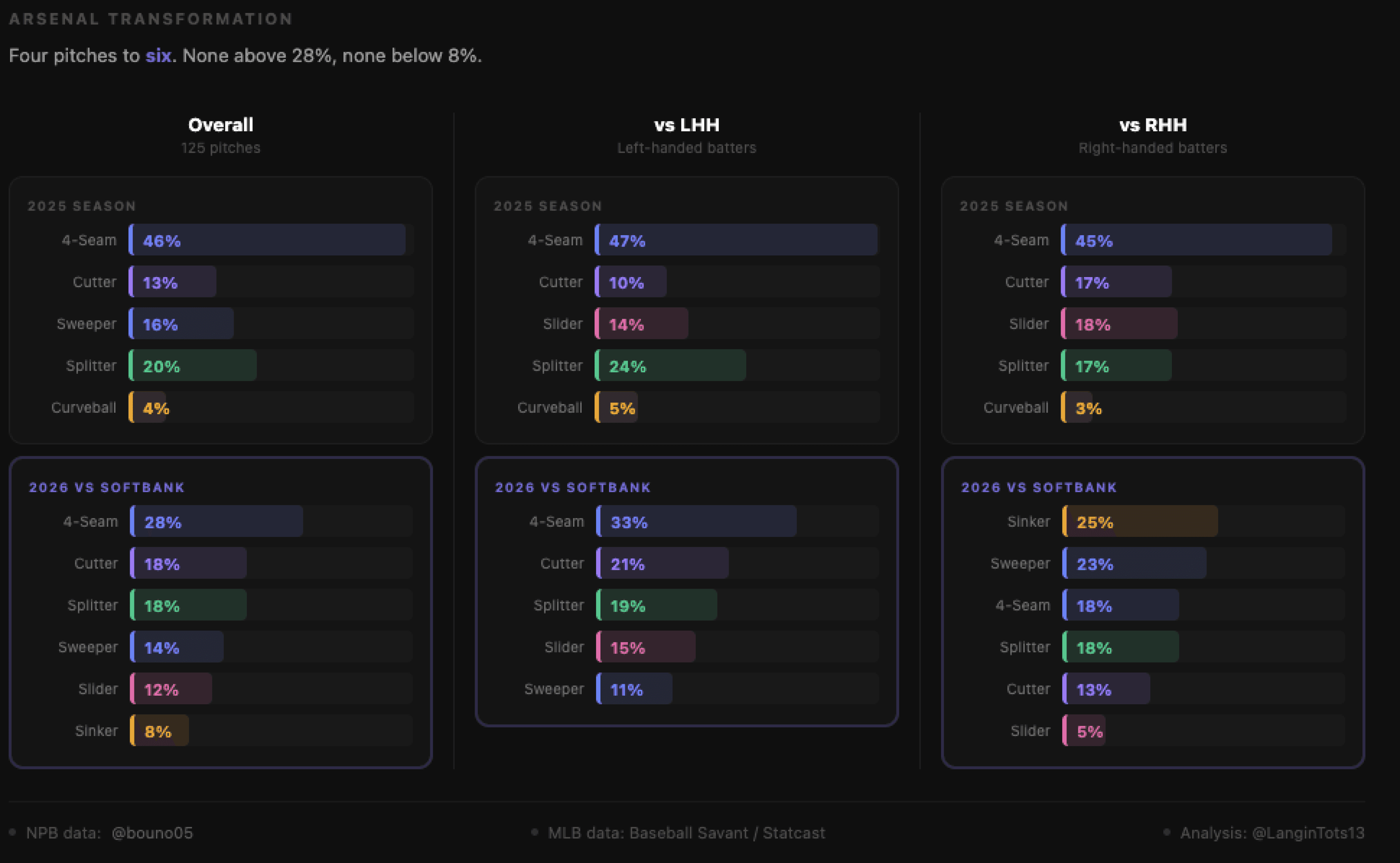
Against the Fukuoka SoftBank Hawks, his slowest four-seam fastball of the night was 93 mph. His average was 94.7 mph across 125 pitches — a career best across any single start. He struck out 11, allowed two hits, walked one. He threw six pitches. None of them exceeded 28% usage and all were thrown at least 8% of the time. Split by handedness, that balance tightened further — his sinker, the least-used pitch in aggregate, was his highest-usage offering against right-handed batters at 25%.
That is not an accident. That is a rebuilt arsenal.
PART 2: THE GYRO SLIDER
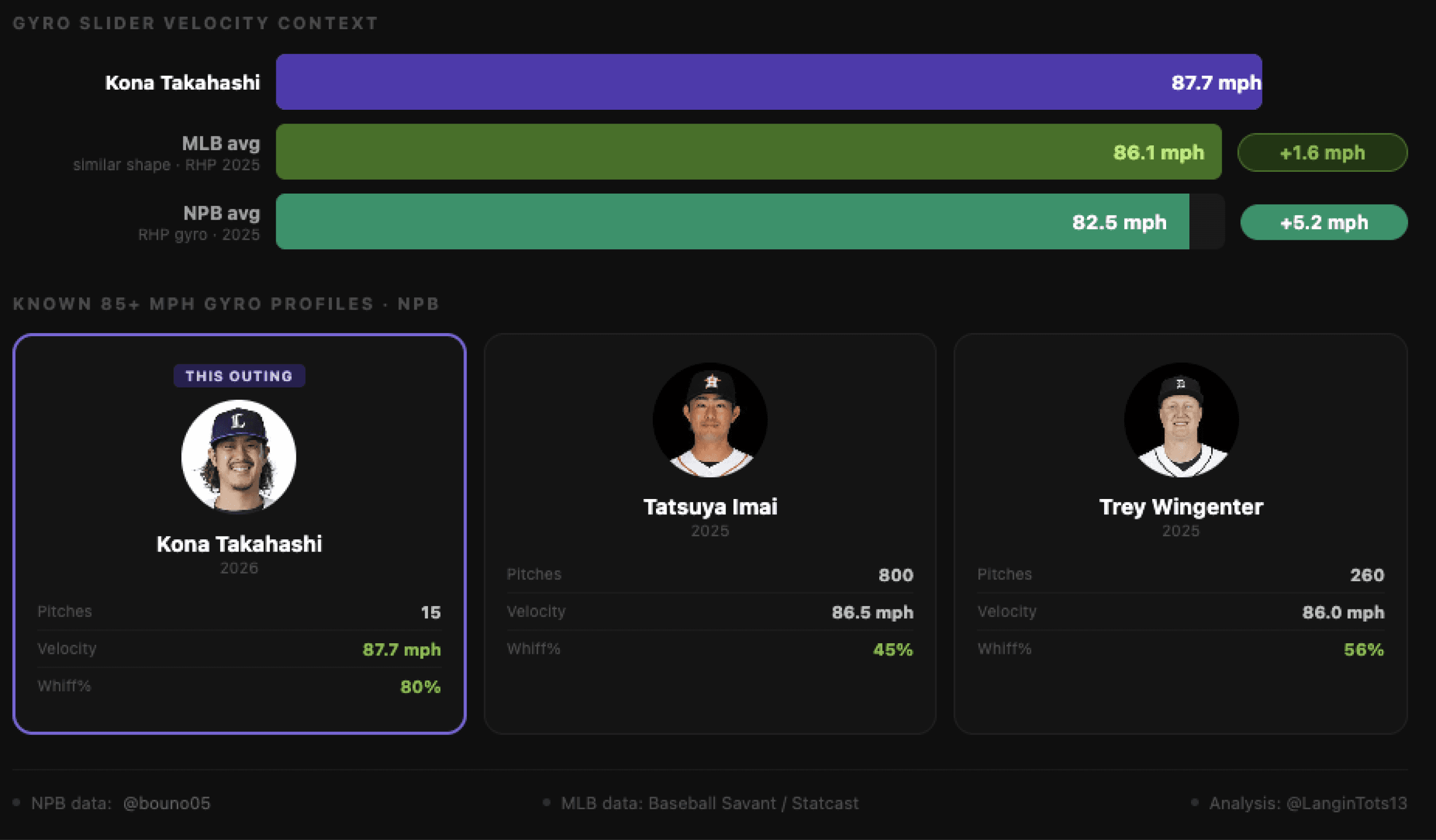
The spiked-grip slider, the spike gyro, is not a new pitch in baseball. It is functionally a rare one in the NPB. Over the last three combined seasons, only one pitcher in the league threw more than 100 of them at 87 mph or above: Tatsuya Imai. The pitch produced a 50% whiff rate across that span, with Imai accounting for the large majority of the sample.
Kona averaged 87.7 mph on the pitch in this outing at effectively 0 inches of both vertical and horizontal break. The average right-handed gyro pitch in the NPB sits at 82–83 mph. That is a 5.3 mph gap on a pitch with near-zero shape. The look is identical, the velocity is not.
To put that in a different context: filtering for similar shapes across right-handed MLB starters in 2025, Kona's version is thrown 1.5 mph harder than the average. The NPB gap is considerably wider. It is immediately an above-average pitch by MLB standards, but its velocity separation in the NPB puts it in its own class. With Imai and Sasaki (now MLB) no longer in the league, the look has no current equivalent. That rarity is earned, and it is a credit to Kona for developing a profile this far outside what the league has seen.
The pitch produced an 80% whiff rate in the outing. That will not scale directly across a full season, but getting into the 40–50% range is significant by any NPB standard, particularly against left-handed batters, and every signal points toward that number holding across larger samples. The rarity factor is not a small part of why.
Left-handed batters in the NPB do not whiff at off-speed pitches that aren't splitters. The gyro, at this velocity and at near-zero break, is one exception. [For the full NPB platoon penalty breakdown, see the Imai analysis.] His splitter previously carried the strikeout load against left-handed hitters. Adding a second legitimate weapon in that matchup was not a luxury. It was the most important thing his arsenal was missing.
PART 3: THE SINKER
When evaluating Kona's results and who he is as a pitcher, one number stood out. His four-seam fastball produced ground balls above 50% consistently across two seasons, and ground ball rate is not really what drives performance on a four-seamer, not in the traditional sense. The pitch isn't designed for it. But the magnitude of the outcome in that specific category was hard to ignore, and it pointed somewhere. A vertically-dominant pitch generating ground balls at that rate means hitters are already contacting late or on top of the ball, and that tendency, if real, had implications for what a pitch actually designed to sink could do in the same arsenal.
If a pitch not designed to sink is already generating ground balls at an elite rate relative to its shape, the threshold to lean into that with a pitch that actually targets ground balls and receive results scaled to the sinking profile of that pitch, commensurate with that same expectation, was the primary process behind adding the sinker.
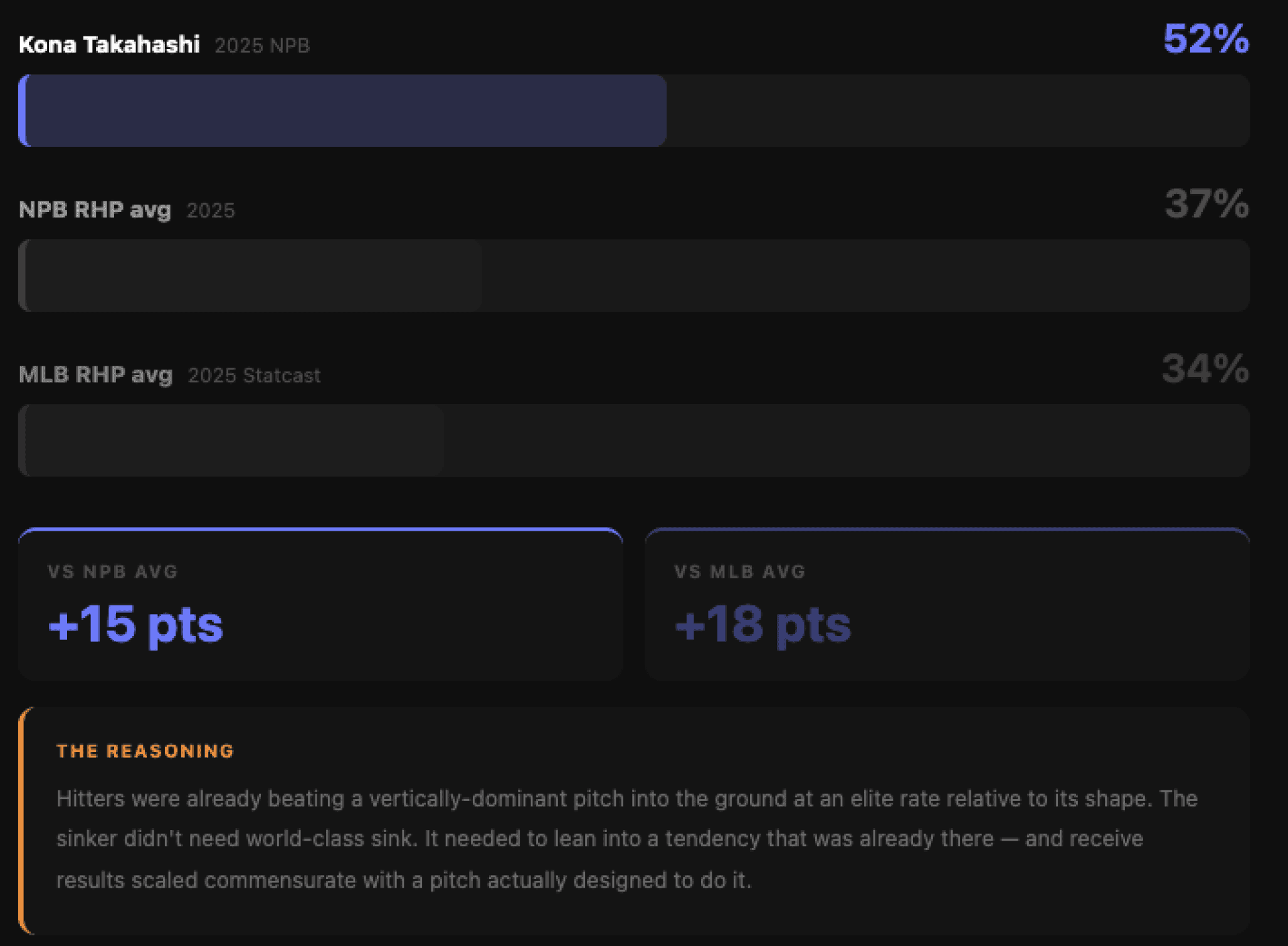
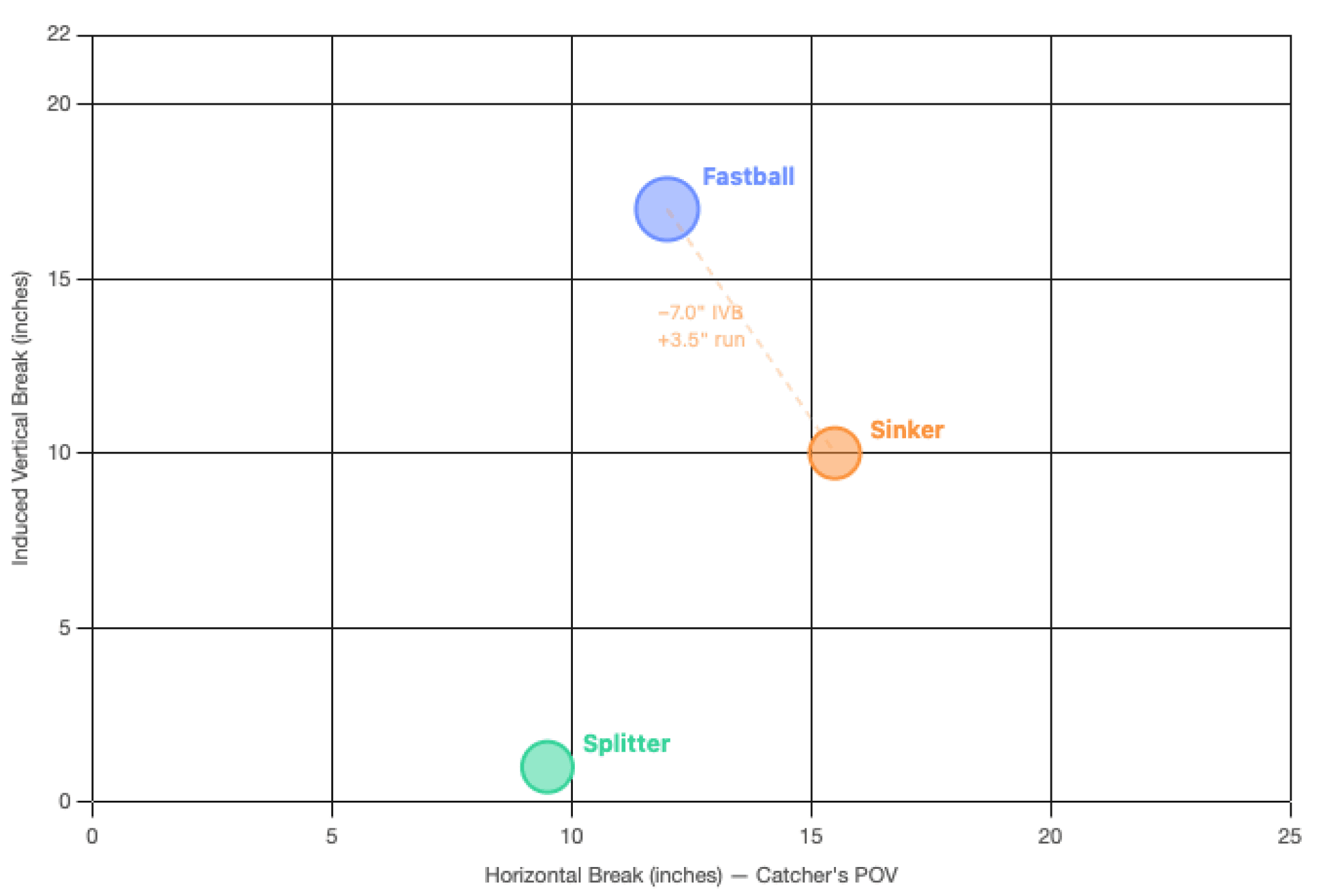
The answer was the one-seam fastball. A grip designed for pitchers with a higher pronation tendency who don't naturally cut the ball, it adds arm-side run and drops the pitch into a completely different vertical bucket while still reading as a fastball out of the hand. The sinker didn't need elite drop to work here. The contact tendency was already there. Adding run and downward tilt to a pitch hitters were already beating into the ground was the inference, and his first outing with it supported that.
In the SoftBank game Kona threw ten sinkers. The first was a ball. The next nine produced strikes, three ground ball outs, and three swings and misses on a pitch he has not yet fully ramped to its ceiling velocity. The command and situational usage were already where they needed to be, which for a newly developed pitch is often the harder thing to find.
PART 4: THE SWEEPER
Kona has thrown a sweeping pitch across the past three seasons, with the results clearly being best in 2023. That version sat at 82.9 mph and produced a 16.5% swinging strike rate. Over 2024 and 2025 the pitch slowed, took on more curveball-like depth, and the swing-and-miss dropped with it — 13.7% in 2024, 11.9% in 2025. The shape drifted away from what made it work.
The grip shifted during his time here, and the current version is the closest it has been to 2023 form. Velocity is back up to 83.0 mph from 81.1 mph last season, a gain of 1.9 mph. It has added 2.5 inches of lateral sweep and shed roughly half its depth, returning it toward the tighter, later-breaking profile that generated whiffs rather than the slower, loopier shape it had become.
With the sinker and gyro now absorbing usage that previously fell to the sweeper in uncomfortable counts, the pitch is operating in the contexts that suit it. That matters for shape consistency across a long season, and the current version of the pitch is the best it has been since 2023.
PART 5: THE SPLITTER AND THE REST
The splitter is Kona's. It has always been his. It averaged 89.5 mph in this outing at near 0 inches of vertical break and produced elite swing-and-miss numbers. He had an uncharacteristic first start with it earlier in the season but the shape and execution here were both back to full form.
Nothing to fix. Nothing to add.
His four-seam and cutter are thrown with selection context behind them now. They are pitches he chooses among six options, not pitches he has to throw. That distinction matters when two-strike counts are backed by a gyro, a splitter, and a sweeper. The data on this is pretty clear — across the last three seasons his splitter and sweeper generated three times the swing-and-miss of his four-seamer, and his off-speed pitches produced nearly double the strikeout rate of his fastball in two-strike counts despite similar volume. And that was before the velocity bump, before adding an elite whiff-generating gyro slider with no current NPB equivalent, before reshaping the sweeper back to the best form it has been across those three seasons, and before the sinker gave right-handed hitters an entirely different problem to solve. Those outcomes were observed in a prior version of this arsenal. What they imply about the current one is a reasonable thing to sit with.
Hitters in the NPB face the same rotation of teams repeatedly across a 143-game schedule. Depth of options mitigates that familiarity effect in a way that a four-pitch arsenal simply cannot.
On current shape comparisons, his gyro slider profiles above the MLB right-handed starter average for the pitch type. His splitter is thrown at 89.5 mph with 9.5 inches of arm-side run and near-zero vertical break, a shape that generates elite swing-and-miss numbers globally. His sweeper to right-handed batters, now at 83.0 mph with 12.5 inches of sweep, is back at the velocity range where it has historically done its best work, and the shape is better than it was then.
PART 6: WHY THE VELOCITY WENT UP
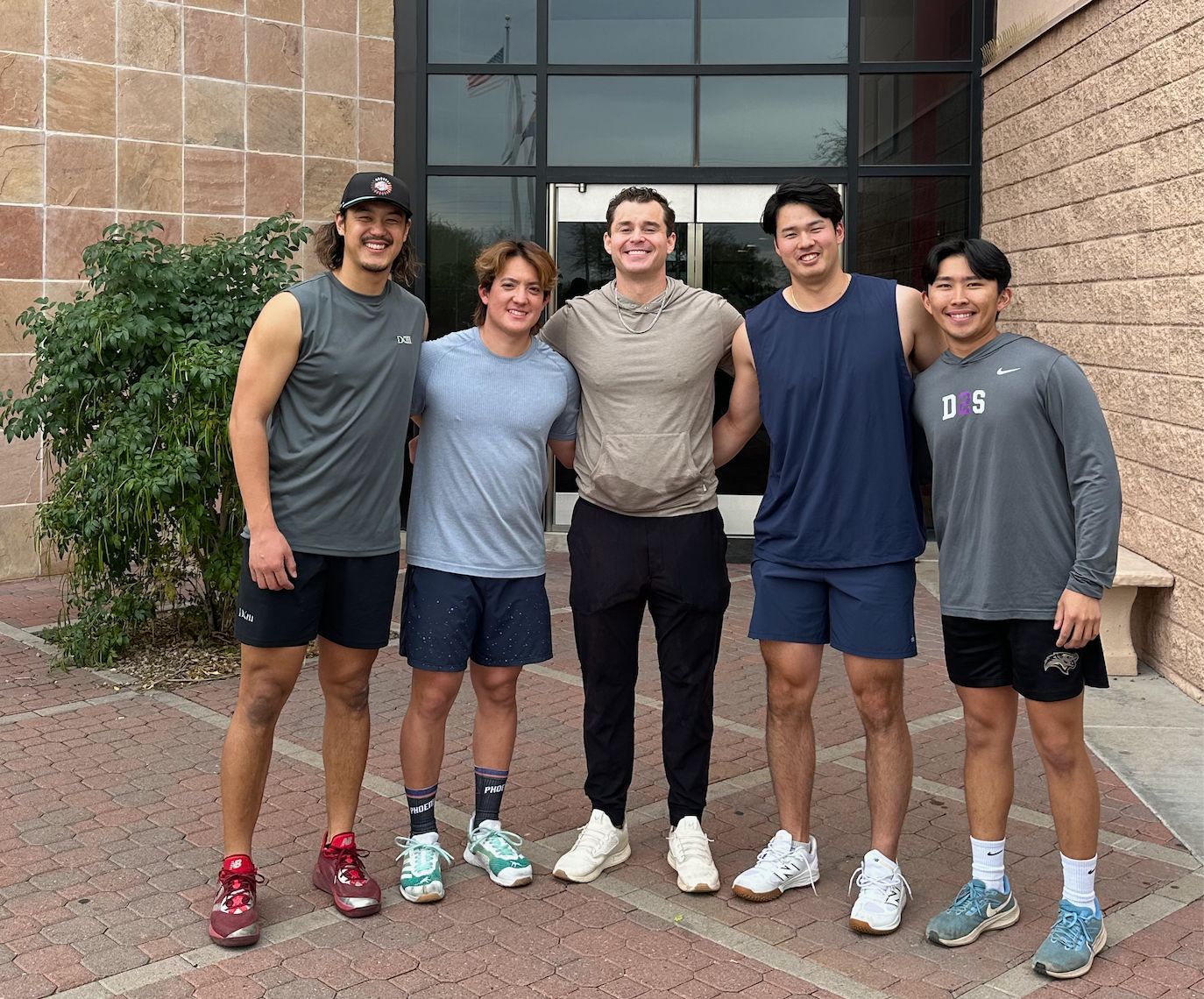
Kona came to Scottsdale in January alongside Seibu Lions teammates Yutaro Watanabe and Kaito Yoza. The motion capture session was hosted by Dean Jackson at Terra Sports, and appreciation to both for the facility access and for Dean's ability to work off observed averages across a large sample of high-level arms. The data produced some clear findings, and one important positive that deserves to lead.
Kona is an efficient linear mover. His center of gravity velocity at peak knee height ranked in the 81st percentile relative to the 94+ mph group in the dataset, moving down the mound measurably faster than the comparison group at that phase of delivery. For a pitcher whose velocity has been trending upward, this is the physical foundation that makes sustained improvement credible.
The arm action told a different story.
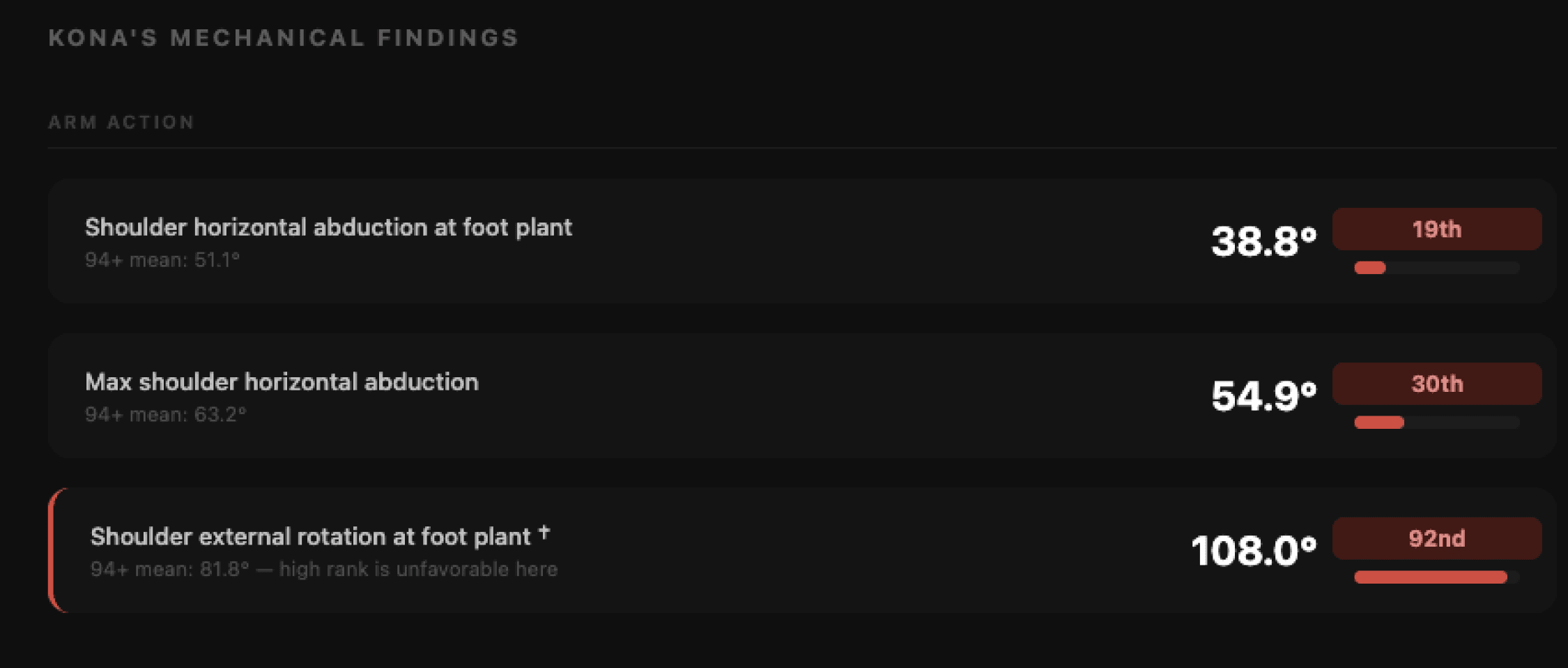
His shoulder external rotation at foot plant was 108°, sitting at the 92nd percentile of the 94+ group, which is not a positive in this context. A higher number here means the arm is up and loaded earlier than average. If you think of loading a punch before throwing it forward, a flatter initial takeaway creates more room to accelerate through the full range of motion. An arm already high and externally rotated at foot plant has less runway to build that stretch.
The downstream consequence showed up in his scapular retraction numbers. His max shoulder horizontal abduction, the measure of how far back the scap pulls to load the pec, was at the 30th percentile of the 94+ group. At foot plant that number dropped by nearly 30% from an already below-average peak. The comparison group loses closer to 15–20%. Less scap retraction at foot plant means less pec stretch, which means less force to potentially apply to the ball.
The hypothesis was that Kona was tensing up early with the baseball, cutting off the loose whippy range of motion needed to build that stretch. The arm being too high too early at foot plant was the visible correlate. Drill selection during the training block targeted a flatter takeaway pattern and a delayed load, getting the back side of the body loaded before the forward drive initiated.
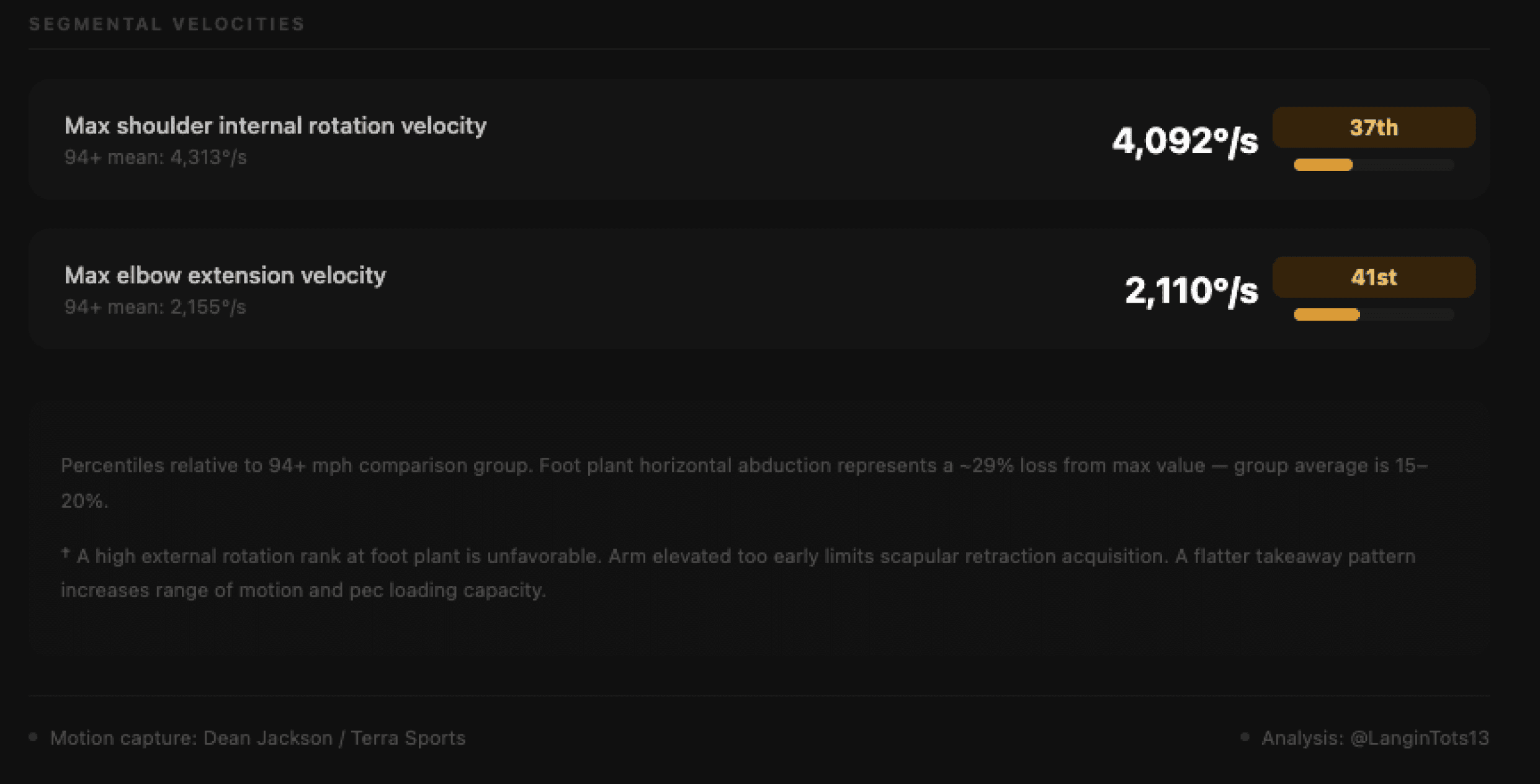
The velocity results suggest the hypothesis had merit. Kona's engagement with those concepts during a low-stakes off-season environment, developing his own feel for the movement and providing his own trial and error feedback, was likely as valuable as the data itself.
PART 7: WHAT COMES NEXT
Not every start will look like this. Kona knows that and so do I.
What has changed is not one outing. It is the underlying inventory, six pitches each with a defined role, each executed in the right context across 125 pitches at a career-best average velocity. That shift is visible even across just two outings this season, and there is still work ahead.
The process behind the results is as encouraging as the results themselves.
The work continues.
END NOTES
Acknowledgments
Motion capture hosted by Dean Jackson at Terra Sports, Scottsdale, AZ. Strength assessment support provided by Rick Gannon. Facility support for the Scottsdale training block provided by Dynamic Sports Training, grateful for the environment they provide for players committed to getting better.
Sources
NPB pitch data: @bouno05 via npbpitchprofile (npbpitchprofile-stjm6eueundydvjbqfxlbv.streamlit.app).
MLB pitch data: Baseball Savant / Statcast. Pacific League official statistics: npb.or.jp.
All pitch metrics are from the 2025 NPB regular season or the April 8, 2026 outing vs. Fukuoka SoftBank Hawks unless otherwise noted.
Image rights
Headshot of Kona Takahashi is the property of NPB / Pacific League. Headshot of Tatsuya Imai is the property of NPB / Pacific League. Headshot of Trey Wingenter courtesy of MLB / Detroit Tigers. All rights reserved. Used here for informational and analytical purposes only.
Analysis: Unfiltered Labs / Chris Langin (@LanginTots13)