Written by
Chris Langin
15 min read

Introduction
Taisei Ota is the structural case study for why pre-ball-flight characteristics matter.
This piece will cover his release height and extension combination — functionally unique in professional baseball — and how 96 mph from a 4.25-foot release point creates an apples-to-apples velocity comparison relative to his release bucket that Ota obliterates. His projected approach angle would be the flattest in the sport by a quarter of a degree, his command profile is elite given the difficulty of what he's doing physically, and the MLB strike zone would put his fastball in position to thrive.
PART 1: THE RELEASE POINT
Taisei Ota releases the baseball from 4.25 feet.
In a sport where nearly every velocity model, swing-decision framework, and pitch-design principle is built around release heights between 5.3 and 6.3 feet, Ota operates from a window that barely exists at the major league level.
MLB had roughly 1,500 four-seam fastballs thrown from between 4 feet and 4.5 feet in 2025. That alone — 1,500 pitches across 2,430 games in a full season — tells you how rare this release window is before you account for anything else.
Those ~1,500 pitches carried a 14.5% swinging strike rate and a 30% whiff rate. They were in the zone 51% of the time — these were not waste pitches thrown exclusively up and out of reach. They were competitive strikes that hitters could not square.
For context, the MLB average four-seam whiff rate is about 21%. Across all pitchers who threw at least 500 four-seamers, only about 3-5% put up a 30% whiff rate over that sample — and those are almost exclusively relievers.
The sub-4.5-foot release height bucket produces that rate as its average. Before accounting for velocity, extension, or any individual pitch characteristics, the geometry alone is doing work that the rest of the league needs elite stuff to replicate.
The release height alone creates a trajectory that bats are not calibrated for. The ball arrives on a flatter plane, enters the zone from a lower origin, and disrupts the swing path that hitters have grooved against conventional arm slots their entire careers.
Ota sits in one of the most productive and least populated release height buckets in professional baseball.
Everything that happens after this is where it gets fun for Ota — and not so fun for major league hitters, if and when he chooses to come stateside.
PART 2: PERCEIVED VELOCITY
The average four-seamer thrown from Ota's release height peers — pitchers releasing between 4 and 4.5 feet, which I'll use as the reference group from here — was 90.6 mph with 6.50 feet of extension.
When you adjust for extension — which shortens or lengthens how far the pitch must travel before reaching the plate — the average perceived velocity in this bucket was 91 mph. Extension doesn't change the radar gun. It changes how much time the hitter has.
Ota averaged 95.8 mph in his WBC appearance against South Korea, consistent with his 95.4 mph average across NPB. His extension measured 7.80 feet — among the longest in professional baseball worldwide.
For context, the MLB extension leaders in 2025:
Pitcher | Extension |
|---|---|
Alexis Díaz | 7.70 ft |
Tyler Glasnow | 7.60 ft |
Logan Gilbert | 7.60 ft |
Jacob Misiorowski | 7.60 ft |
Taisei Ota | 7.80 ft |
Ota's release point is approximately 1.30 feet closer to the batter than the average pitcher in his release height bucket. That distance doesn't need to be covered through ball flight. The pitch doesn't slow down over that 1.30 feet of air. It just isn't there.
This gives him a perceived velocity of approximately 98.5 mph.
The average pitcher from this release height feels like 91 mph to the hitter. Ota feels like 98.5. That is a 7.5 mph perceived velocity advantage over the average arm in his slot.
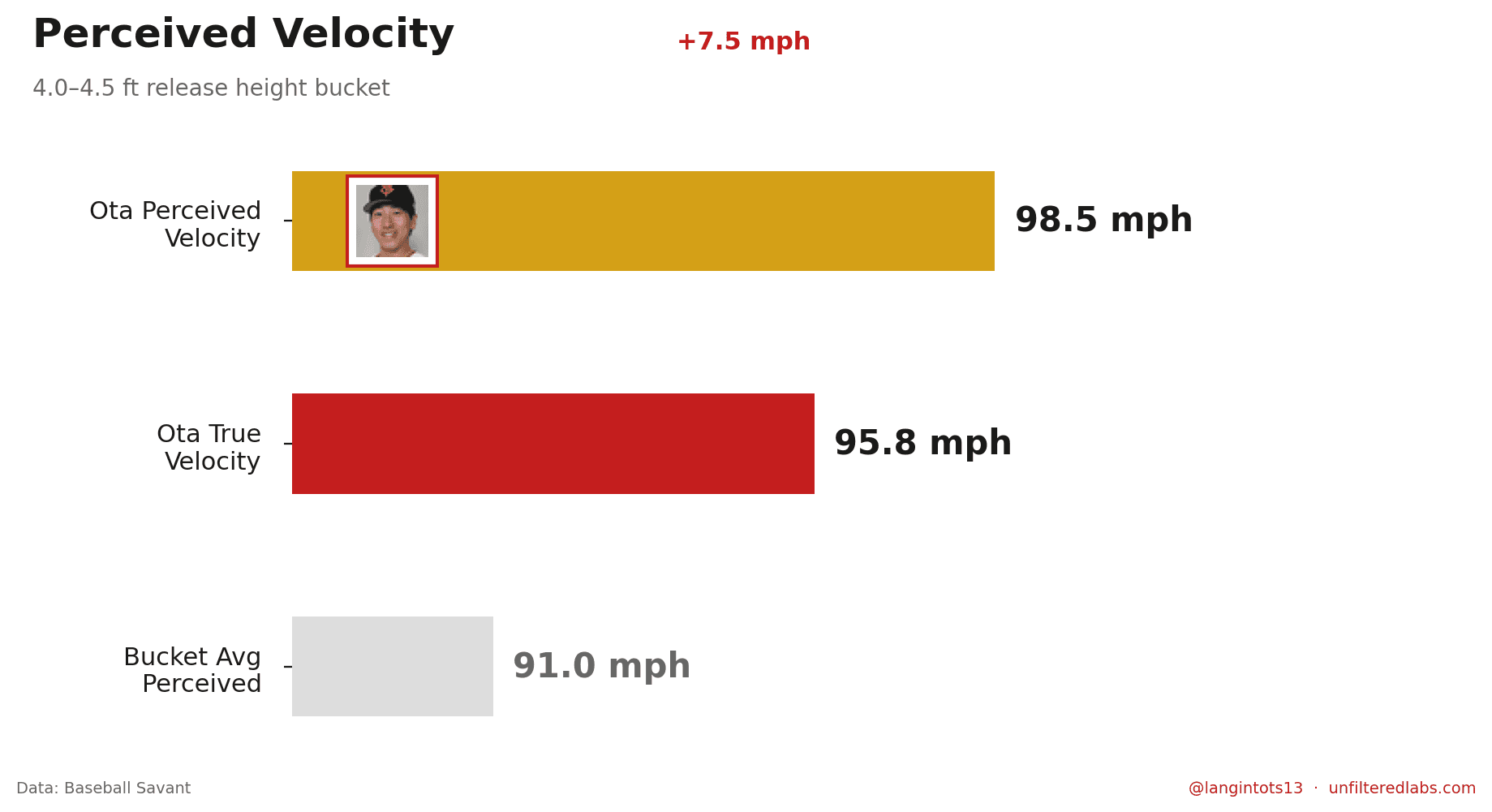
Ota is throwing harder than the average right-handed pitcher in baseball — but doing it from an arm angle and release height that usually, very literally, demands 5 mph less on average. That perceived velocity advantage is large enough to be worth writing about here.
There have been 85 four-seam fastballs thrown in Ota's release height bucket at 95.8 mph or harder this decade. In the entire major leagues. Ota threw 224 of them in the NPB last season alone, averaging 99 mph of perceived velocity on those pitches. This is effectively the only pitcher in the world right now who is able to accomplish this type of velocity from this release height.
PART 3: THE APPROACH ANGLE
Vertical approach angle is where all of these components — release height, extension, velocity — converge into a single metric that tells you how flat the pitch arrives to the hitter. You can read more on VAA here.
Using upper-third in-zone four-seamers over the last 3 years (minimum 200 thrown), here is how the 20-80 scale maps to VAA:
Grade | VAA | Reference |
|---|---|---|
50 (Average) | -4.35° | MLB mean |
60 | -3.95° | — |
65 | -3.75° | — |
70 | -3.50° | Bryan Woo / Joe Ryan |
75 | -3.25° | Edwin Uceta |
80 | -3.20° | Paul Sewald (flattest in MLB) |
80+ | -2.95° | Taisei Ota (projected) |
Sewald currently owns the flattest upper-third VAA in the dataset at -3.20°. Uceta is right behind him at -3.25°. Both are elite.
Ota's projected VAA of -2.95° — based on his 4.25-foot release height, 7.80-foot extension, and 95.8 mph velocity — grades as 80+. That's over 3 standard deviations above the mean.
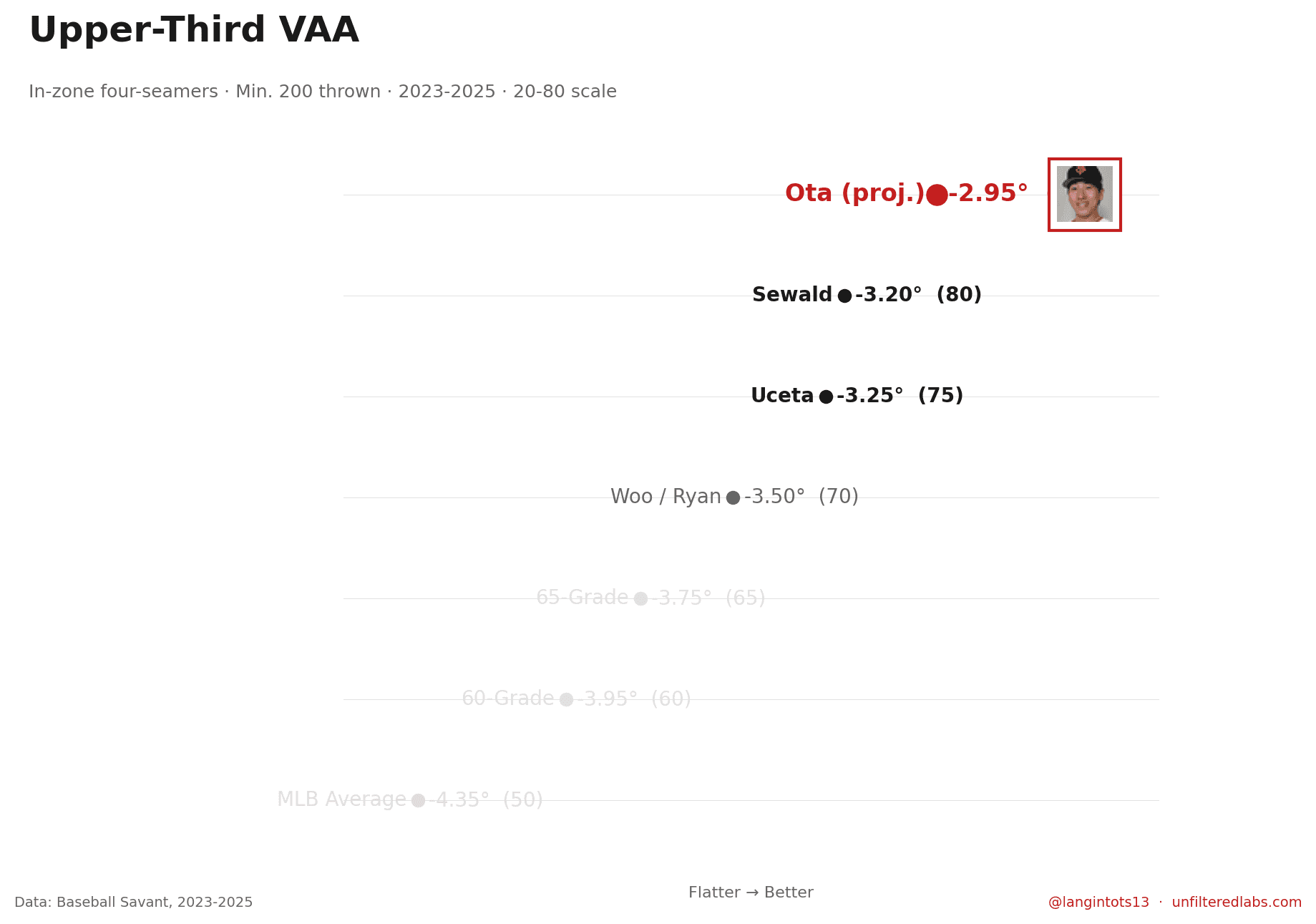
He would not just lead this dataset. He would be roughly 0.25° flatter than anything currently in professional baseball. No pitcher in the sample — across 243 qualifiers over three years — comes close.
The flattest VAA in MLB belongs to a pitcher throwing 91.6 mph. Ota would beat it while throwing 4 mph harder.
PART 4: THE MOVEMENT DATA
Ota threw 7 pitches in the 9th inning against South Korea. Six fastballs, one changeup. Here are the fastballs:
# | Velo | IVB | HB | Spin | VAA | Result |
|---|---|---|---|---|---|---|
1 | 95.6 | 9.5" | 18.0" | 2423 | -4.5° | Fly out |
2 | 96.4 | 8.0" | 17.5" | 2356 | -3.2° | Called strike |
3 | 94.6 | 12.5" | 16.0" | 2336 | -2.5° | Swinging strike |
4 | 96.1 | 11.5" | 17.0" | 2466 | -1.9° | Ball |
5 | 96.4 | 10.5" | 17.0" | 2458 | -4.0° | Fly out |
6 | 95.7 | 6.5" | 19.5" | 2359 | -4.9° | Ground out |
The tracking system tagged his fastball as a sinker. For the purposes of this analysis, I'm treating it as a four-seam — the pitch averaged 10.5 inches of induced vertical break, which is right at the average for four-seamers thrown from this release height in MLB. He may blend grips between a sinker and a four-seam, which would be interesting if confirmed — it would mean there's additional carry available beyond what the averages show. But for now, 10.5 inches of IVB is the working number.
What stands out is that 10.5 inches of vertical break from this release height is already effective. The average four-seamer in the sub-4.5-foot bucket carried the same IVB, and those pitches generated the 30% whiff rate referenced above. Ota matches the movement baseline while throwing 5 mph harder and releasing the ball over a foot closer to the plate.
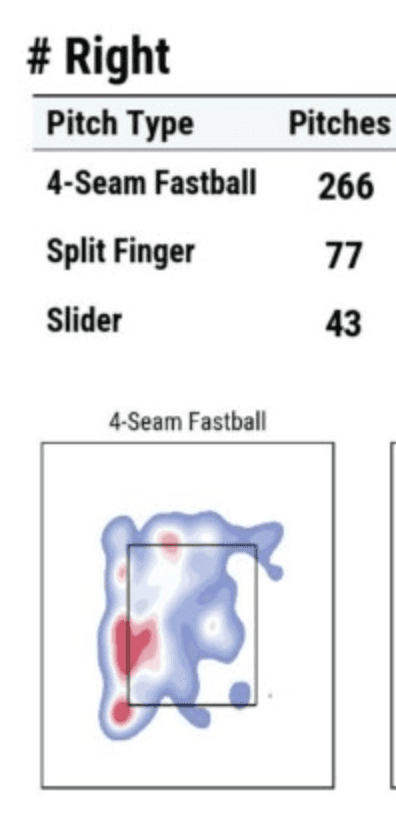
His NPB location data, via NPB Pitch Profile, shows something important about projection. His four-seam heat map is stacked low and arm-side — where NPB rewards the pitch in that culture. But that is not where it would be thrown in a rules-based strike zone like MLB has, where the top of the zone is enforced and called. Based on the comps below, you can see why his projection in the major leagues is immense if he comes over with this velocity and elevates his heater.
PART 5: THE COMPS
There are very few pitchers in MLB who operate near Ota's parameter space. The two closest:
Pitcher | Velo | IVB | Extension | Rel. Height | PV Est. |
|---|---|---|---|---|---|
Edwin Uceta (TB) | 94.0 | 12.5" | 6.20 ft | 4.40 ft | ~95 |
Kevin Kelly (TB) | 92.3 | 10.5" | 7.20 ft | 4.25 ft | ~95 |
Taisei Ota | 95.8 | 10.5" | 7.80 ft | 4.25 ft | ~98.5 |
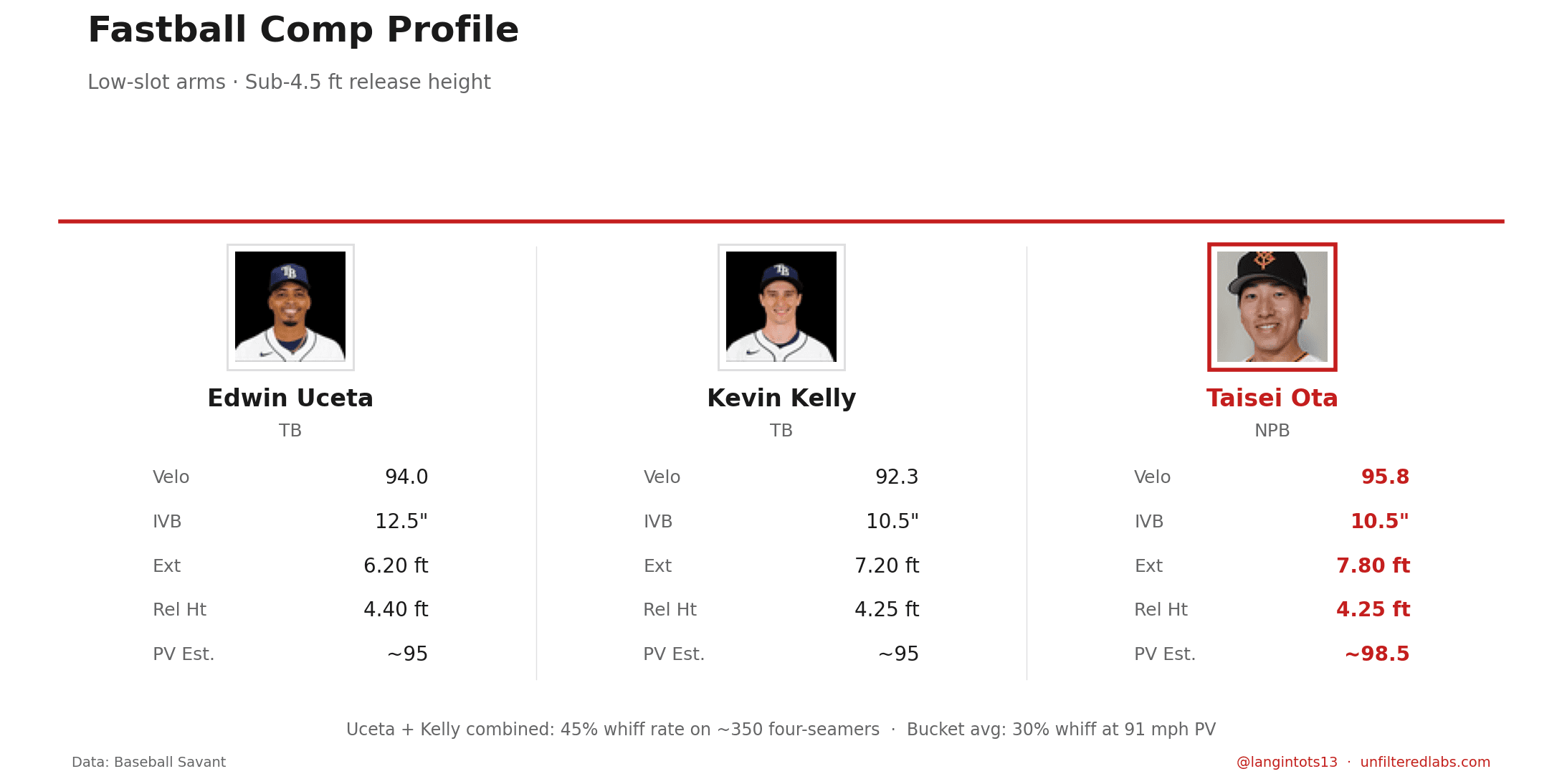
Uceta carried a 44% whiff rate on his four-seamer — it's unlikely he sustains that through a full career. But the fact remains: the 30% whiff rate was the base average amongst Ota's release height peers, thrown at 5 mph slower velocity and 1.30 feet further from the hitter. That 30% whiff rate is already deadly. Now keep Ota's 7.5 mph perceived velocity advantage in mind.
Ota throws 3.5 mph harder than Kelly. He has 0.60 feet more extension. His release height matches Kelly's at the lowest point of the bucket. And his perceived velocity — 98.5 mph — exists in a tier that neither Uceta nor Kelly can reach.
The projected whiff rate on this fastball in the major leagues, if located up in the zone, has the potential to be historic based on his release and ball flight metrics alone.
PART 6: THE WALK RATE
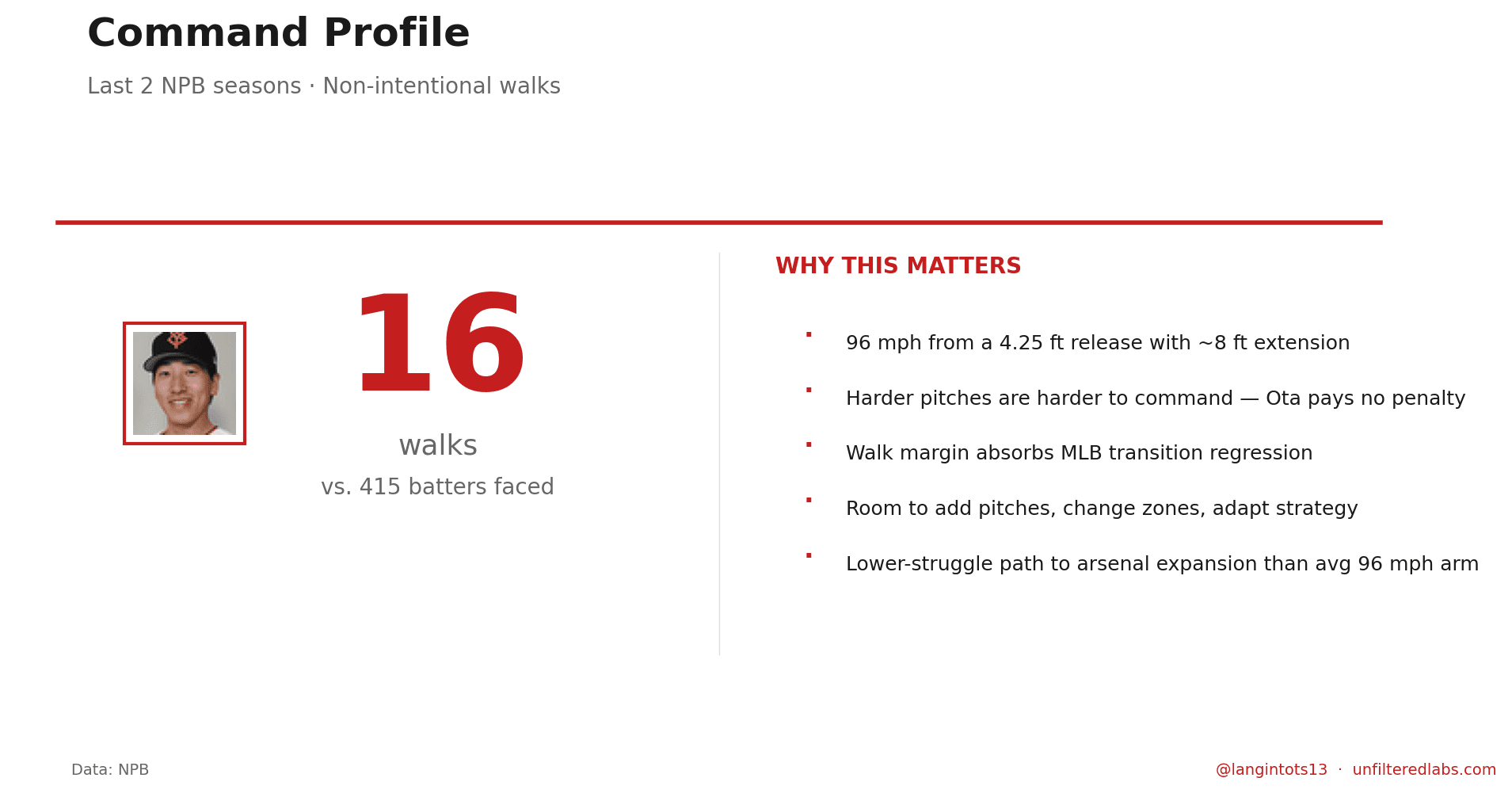
Over the last two NPB seasons, Ota walked 16 batters against 415 non-intentional plate appearances.
A reliever who walks nobody with this velocity and this amount of pure stuff is rare. Harder pitches are generally harder to command — that is just a baseline reality of pitching. Ota pays no command penalty for throwing 96 mph from a low slot with nearly 8 feet of extension.
His command is not only exceptional in general — it is truly exceptional given the difficulty of what he's doing physically. It makes him a high-talent-level pitcher without any adjustments or manipulations to his style.
But it also provides him plenty of luxury. A pitcher with a walk rate this low has room to add a pitch, throw his pitches in different zones, and adapt to environmental advantages that a new league would offer. The feel and ability to recalibrate is clearly there. Monitoring and adjusting base attack areas — or adding a pitch type with some shape — is a lower-struggle, higher-likelihood strategy for a pitcher with Ota's command than it is for the average reliever who throws 96 mph.
Moving from NPB to MLB requires adjustments — different ball, different zone, different hitter behavior, different sequencing demands. Pitchers who walk batters in NPB tend to walk more in MLB during the adjustment period. Ota has so much margin that even a significant regression still leaves him with above-average command. The transition risk, for him, is structurally lower than it is for nearly any other reliever prospect.
PART 7: THE SWEEPER
Ota's current arsenal in NPB is fastball-dominant with a splitter and a slider. The splitter is effective against left-handed hitters — it works as a chase pitch below the zone with arm-side run.
What he doesn't have yet is a pitch that can get a called strike laterally while also generating weak contact and poor swing decisions from the right side. His arm angle creates a natural opportunity.
From a low release point, a sweeping slider with a hard curveball feel and a sweeper grip produces upward vertical break and horizontal sweep. The ball moves on a rising, sweeping plane that conflicts directly with the hitter's bat path — the movement goes up and away while the bat is trying to go through and down. The result is pop-ups, weak fly balls, and swings that can't meet the ball cleanly.
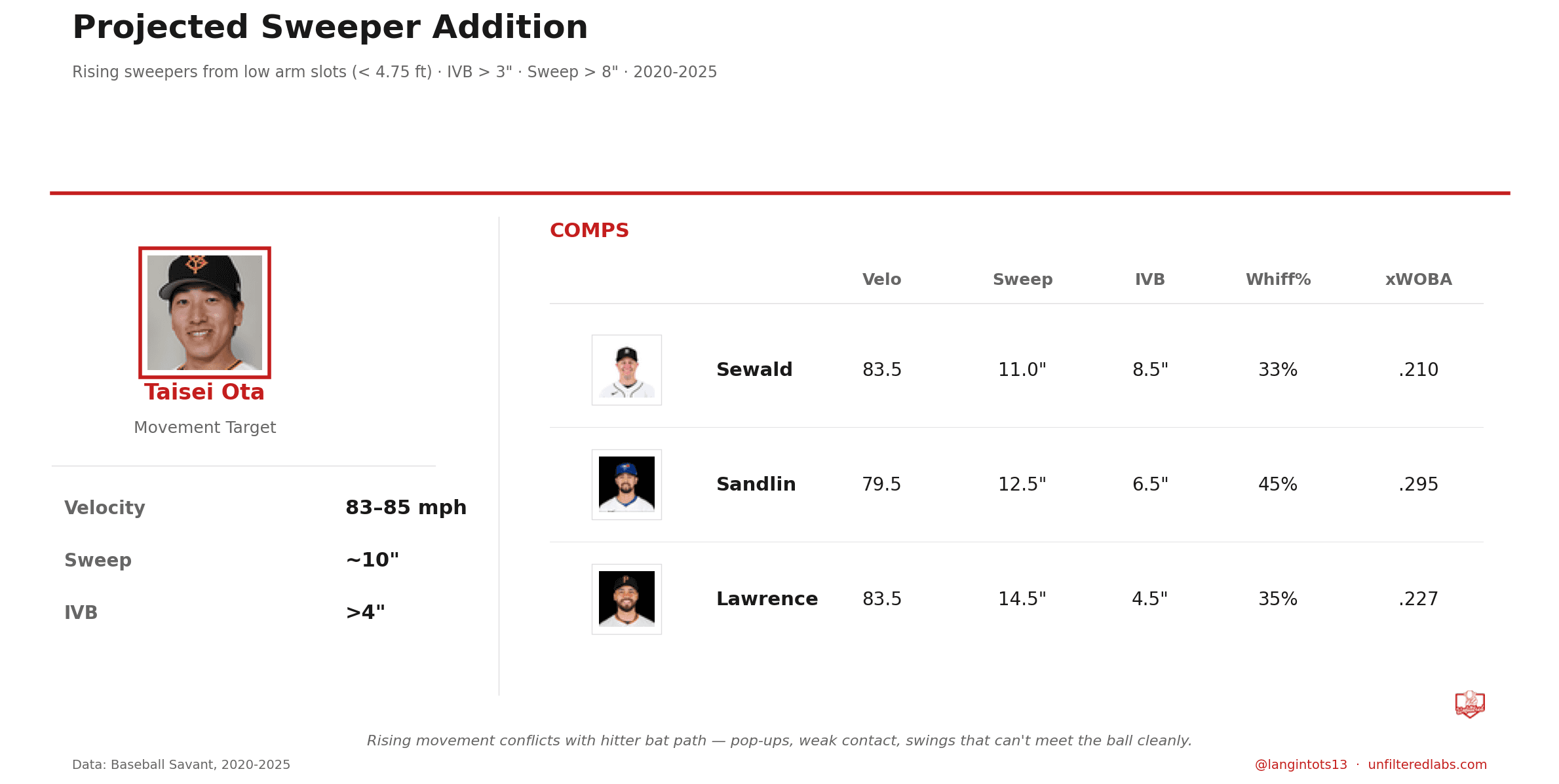
The closest comps for this type of pitch:
Paul Sewald — low-slot sweeper with a rising movement plane. The pitch plays as a called strike when thrown to the back hip of same-side hitters, and generates pop-ups and whiffs when hitters chase.
Nick Sandlin — same arm angle profile. His sweeper carries upward vertical break from the low release and sweeps across the zone.
A pitch in the low-to-mid 80s with roughly 10 inches of sweep and at least 4 inches of induced vertical break would play well for Ota. It would give him a pitch that can land for a called strike to both sides of the plate — something his fastball and splitter, both heavy-action pitches, don't naturally do — while grading well on movement due to the rising effect from his arm angle.
The addition is both tactical and structural. He needs a pitch that can get takes. His fastball and splitter generate action and chase. A sweeper balances the arsenal by giving hitters something they're more likely to watch rather than swing through.
PART 8: WHAT HE IS
Ota's release characteristics could not be more aligned with what major league teams are looking for.
The blend of his low release height and world-class extension are individually rare. Together they are functionally unique. And the fact that he throws 96 mph within these parameters — where the average arm in this bucket barely touches 91 — is the part that makes the profile exceptional rather than just interesting.
He is throwing in the most sought-after release height bucket in baseball. His fastball feels like 98.5 mph to the hitter when the average pitcher in this slot makes it feel like 91. He commands the pitch to the most valuable locations. He walks nobody. And he does all of this at 24 years old.
The NPB strike zone is compressed vertically. Elevated fastballs that would be called strikes in the major leagues are balls in Japan. Ota has not yet been able to fully leverage the pitch that his release profile was built for — the high four-seam fastball in a league that calls it a strike and faces hitters with flatter swing planes who are geared to drive the ball rather than protect against it.
The structure can't be trained. Release height is anatomical. Extension is mechanical and largely fixed by the time a pitcher reaches this level. Velocity at this extension and this release height is the rarest combination of the three.
Ota has all of them.
I find it very likely he will one day be an extremely effective late-inning reliever in the major leagues. The pitch characteristics project. The command projects. The one missing variable — a league that calls the high strike — is waiting for him.
Credits & Data Sources
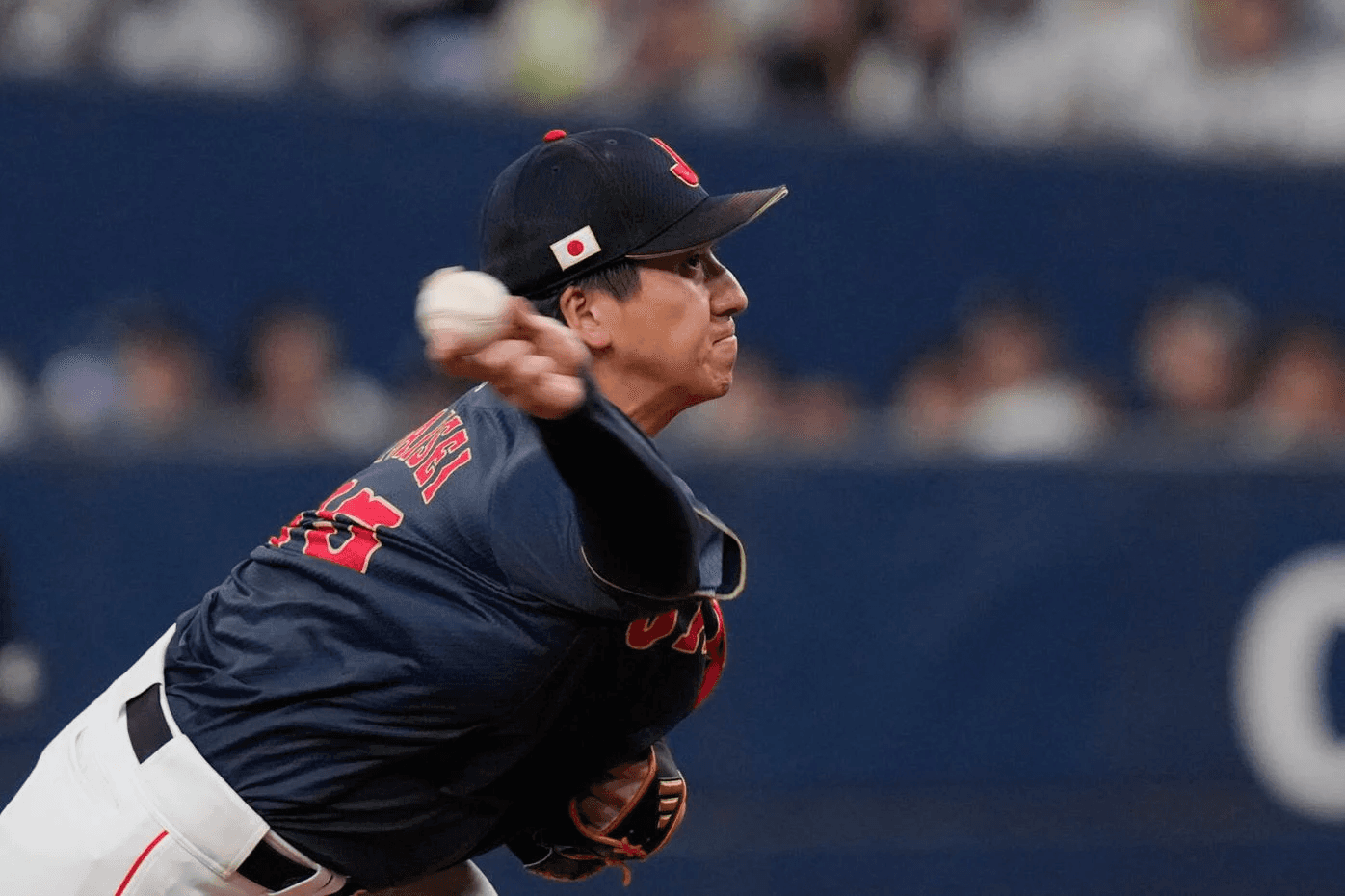
Photo: Kyodo / Kyodo News Images
NPB Pitch Profile (via @bouno05)
WBC 2026 Hawk-Eye data (JPN vs KOR, March 7, 2026)
Baseball Savant / Statcast
NPB tracking data