Written by
Chris Langin
15 min read

Introduction
In December of 2025, I came across a snippet of Tatsuya Imai's pitch data and outcomes from Japan. As someone who works with professional pitchers for a living, there isn't a lot of wiggle room for writing full blogs on someone's free agency profile — especially when you don't train the athlete. But the slider data was interesting enough that I made an exception.
If you're genuinely interested in Imai, read that piece first: Prior Imai Blog
This is an addendum that stays entirely within the lane of his slider. Two MLB starts in, we now have Statcast data — spin-induced movement, efficiency, tilt — information that wasn't accessible in the NPB data I had. The primary use case for pitch physics isn't prediction in my opinion, but rather its quick stability — how fast a profile becomes reliable. We've far crossed the threshold needed for Imai's slider. Now is the time to unravel it.
Because I genuinely think Tatsuya Imai has a monopoly on his pitch he calls a slider.
PART I — What Statcast Now Shows
Velocity | 87 MPH |
Spin Rate | 2,250 |
Spin Efficiency | 26% |
Backspin RPM's | 200 |
Vertical Break | 2" |
Sidespin RPM's | +500 |
Horizontal Break | 4-6" |
Release Tilt | 2:45-3:00 |
Two MLB starts in. The spin profile: 2,250 rpm, 26% spin efficiency, release tilt 2:45–3:00.
Here is what that means when you reverse-engineer it.
Imai puts roughly 500 rpm of armside spin on the pitch and a trace of backspin. Pure bullet spin on the ball vertically. Same as a conventional slider. Slider spin rate. Slider efficiency. Slider release tilt.
Across every metric that shapes how a pitch looks to a hitter pre-release, this pitch looks like a slider.
The one thing he does differently: he reverses the sidespin axis.
Every other pitch in this spin profile and efficiency range spins toward the glove side. His spins arm-side. The pitch arrives looking like a slider and breaks the wrong direction. That's it. That's the whole trick.
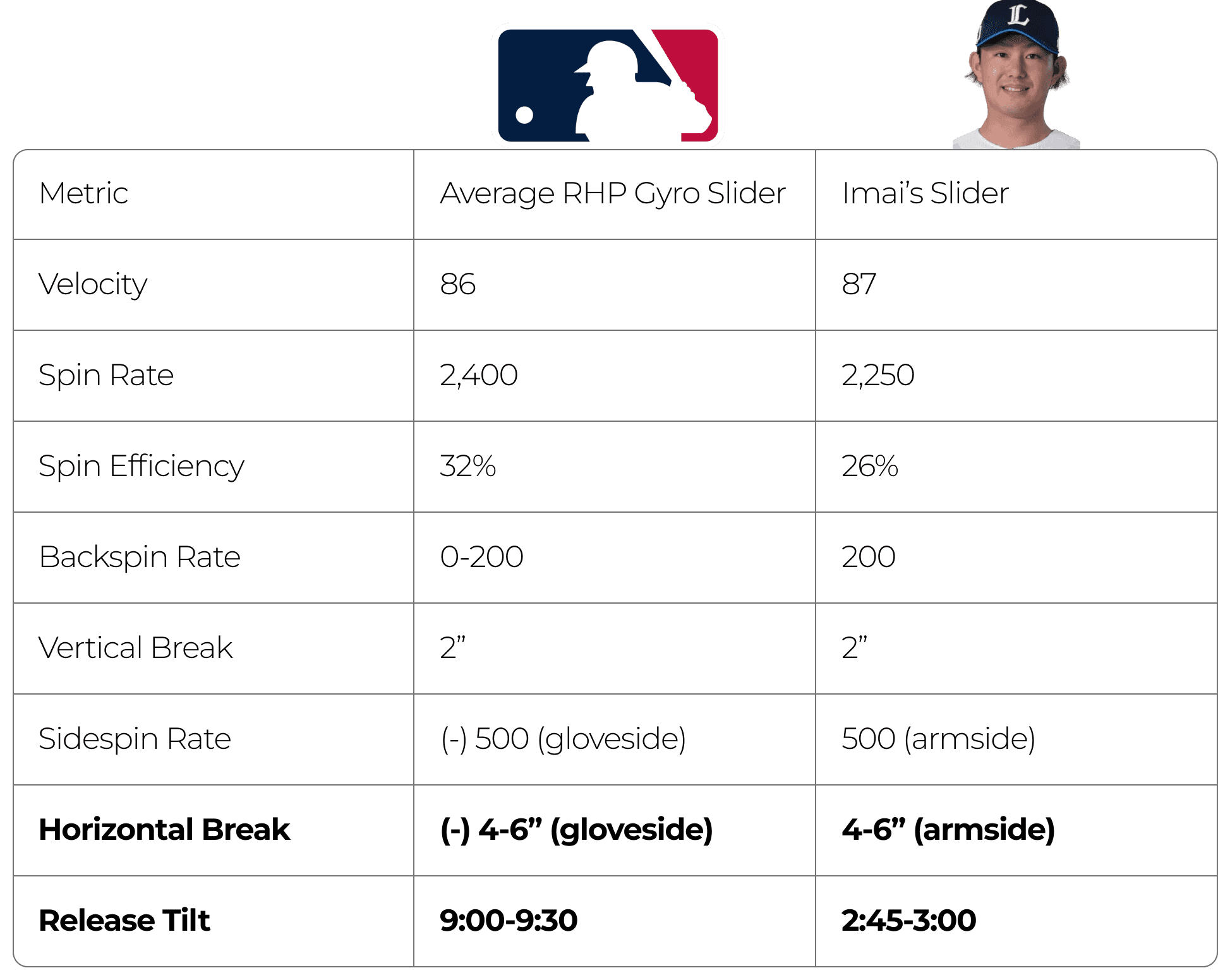
The talent Imai has is not generating an extraordinary velocity or end movement profile. The vertical break, the horizontal break, the velo — none of it is remarkable on its own. The talent is that his route for getting there is completely unlike how every other pitch in that movement bandwidth arrives. Every context clue a hitter can access pre-release — spin rate, efficiency, release tilt — reads as a conventional slider. One component defies it. That is the entire argument I'll make for why this pitch performs, purely from a pitch physics and Hawkeye lens.
The way to validate this is to look at where pitches with similar spin profiles actually end up across the movement zones. Pitches that generate true arm-side movement at the level Imai's does get there primarily via splitter spin. The average spin rate in the movement bucket where Imai's pitch lands is 1,275 rpm. He is +975 rpm above the mean of the movement bucket his ball actually arrives in.
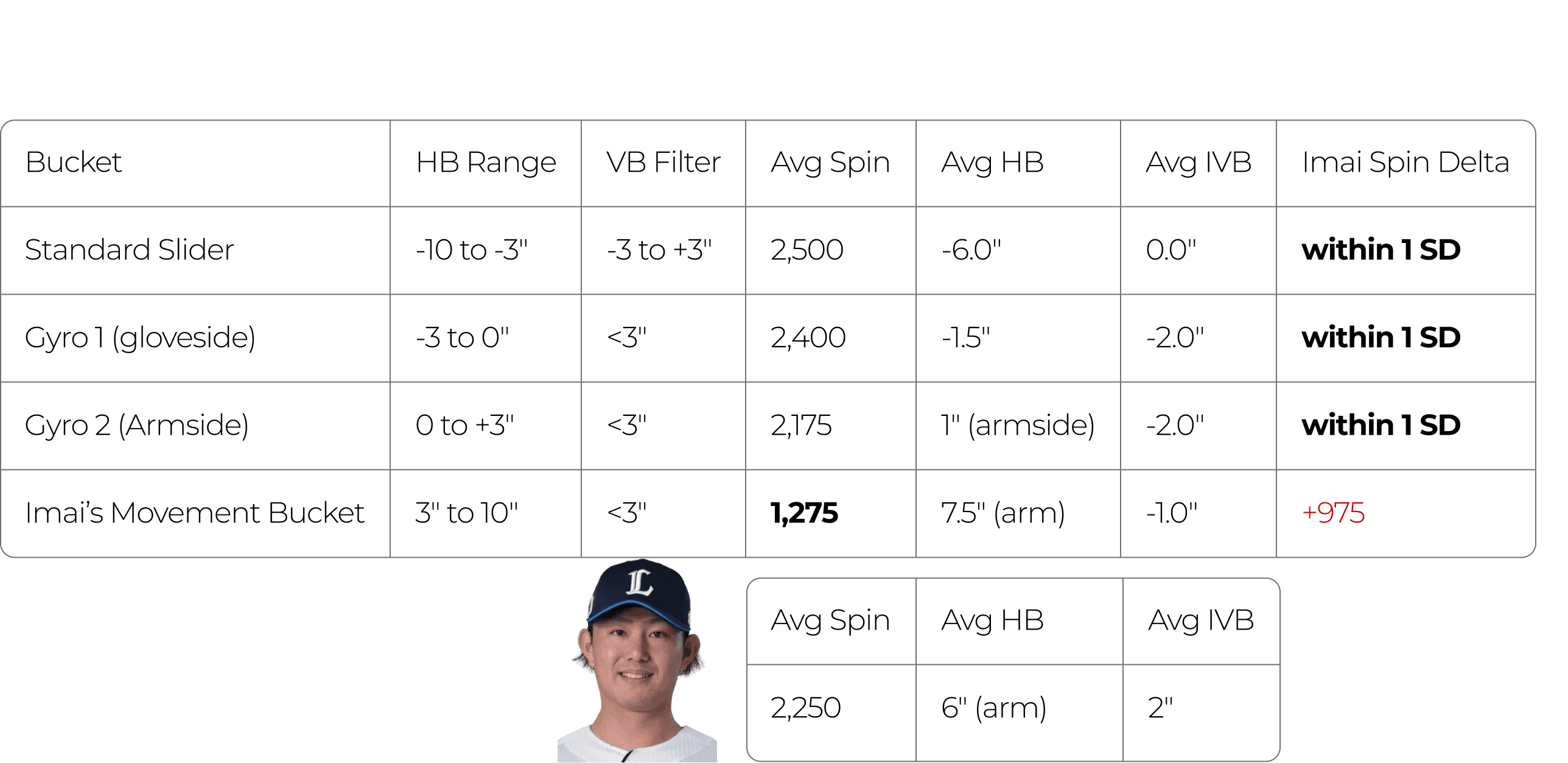
His spin says he's a slider. His movement says he's a low-spin splitter. Nothing in baseball does both at the same time — or at least nothing does it intentionally, consistently, and at this volume.
The reason this matters from a hitter's perspective is that pre-release read is likely a deeply ingrained tool used to determine swing path and swing decision. Every context clue available pre-release reads as a conventional slider. One component defies it. Once you see it and contextualize the pitch this way, it's difficult to unsee — especially given the scarcity of the offering league-wide.
PART II— The Monopoly
Type | SwStrk% | Miss% | Chase% | Strike% | In-Zone% |
RHP Slider Avg | 16% | 33% | 31% | 63% | 45% |
RHP Reverse SL | 20% | 41% | 32% | 62% | 43% |
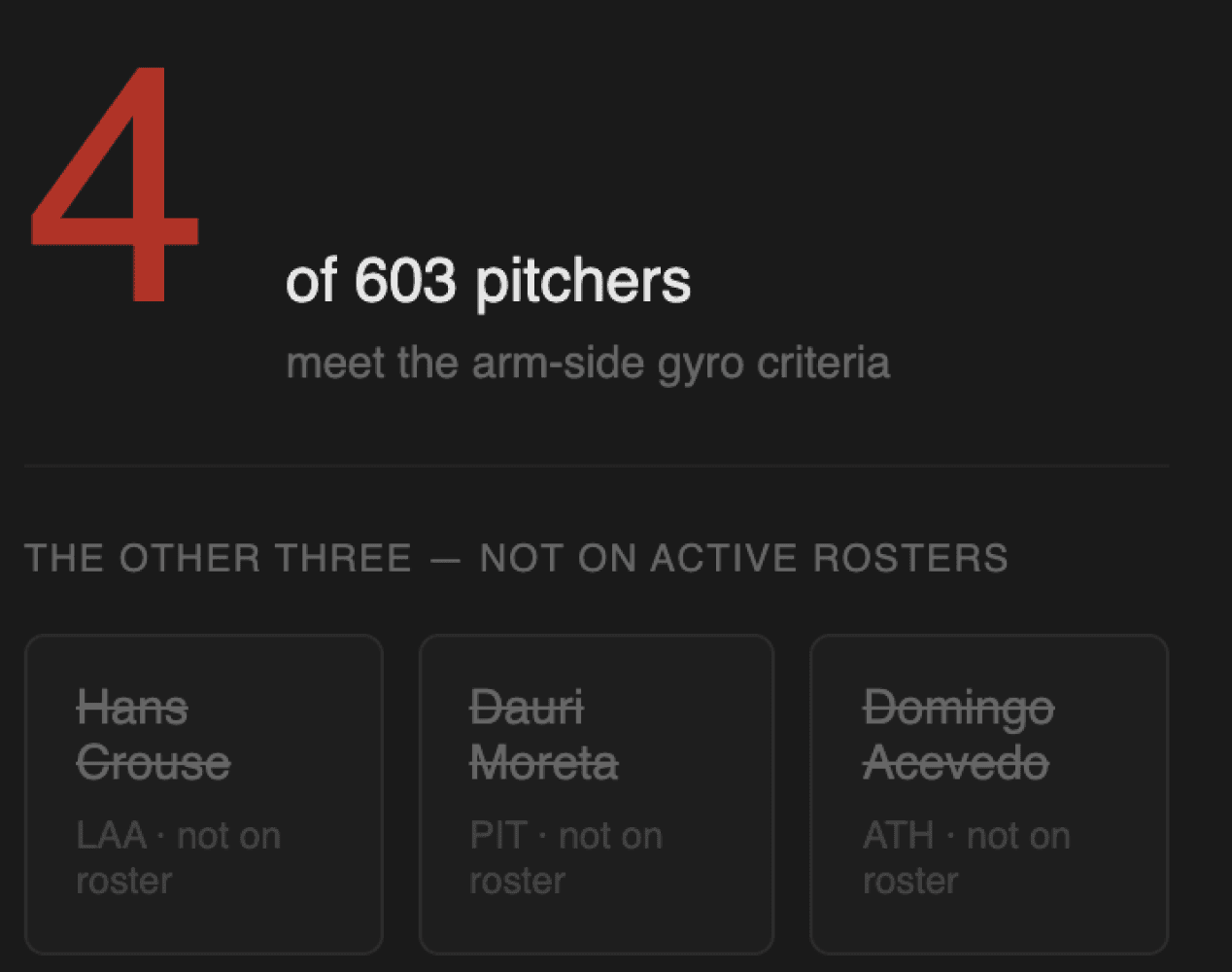
603 pitchers. Four meet the criteria for the arm-side gyro break. Three of those four are not currently active in MLB.
Tatsuya Imai is the only active pitcher throwing this pitch. And he is throwing it at 42% usage — not as an accident, not as a cutter that leaked, not as a slider that missed its target. Intentionally. Repeatedly. As his primary secondary offering.
That distinction matters because the rest of the pitches that populate the arm-side gyro bucket across MLB history are almost entirely noise. The pitches exist in the data but they don't exist as a weapon.
In 2026, based on his current pace, Imai projects to throw approximately 1,197 of these pitches across a full season. The rest of active MLB righties combined — based on the 2020–2025 average of roughly 442 per year across the entire league — will throw the remainder. Nearly all of them accidental. Imai at 73% of all RHP arm-side gyro breaking balls thrown in the major leagues this season. If Moreta doesn't return to MLB action, that number climbs to 81%.

Without Moreta in the league, no pitcher projects to throw more of these than Imai already has through two starts. His 71 reverse sliders would likely lead the league if his season ended today and everyone else's didn't. That is what history tells us — not a projected inference about what the rest of the league will do going forward, but a statement about what the rest of the league has felt compelled to do to this point. Which is nothing.
In any given week of the 2026 season, Imai will throw more intentional arm-side gyro breaking balls than every other right-handed pitcher in baseball combined. By a wide margin. In a sport where pitch type diversification has never been higher, where the collective analytical infrastructure of thirty franchises is constantly searching for edges, and where the information cycle on what constitutes an effective pitch has never moved faster — one pitcher has a pitch type essentially to himself.
This has happened before.
PART III — The Previous Monopoly Holder
Drew Smyly was the first one.
Filter the Hawkeye era for the same reverse breaking ball bucket Imai now occupies — left-handed this time. 2,300 pitches total across the entire league across five years. Drew Smyly threw 1,717 of them. Seventy-five percent.
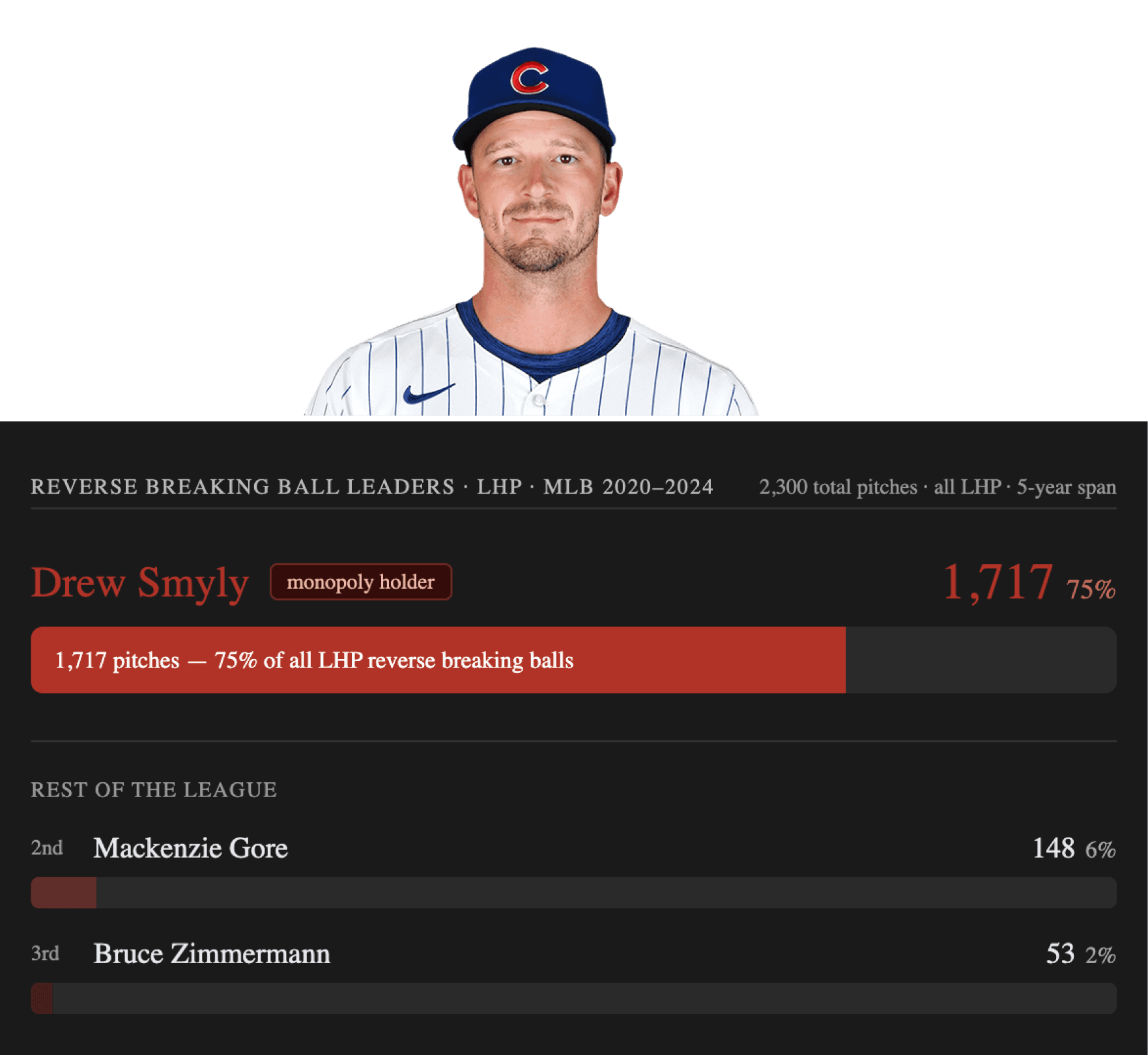
Smyly's curveball graded poorly on stuff models because the best available comparison was the nearest pattern of movement traits that typically define a well-performing curveball. Smyly's velocity was that of a curveball and his induced vertical break that of a slider — not a combination that grades well without significant sweep. He had none.
But the pitch didn't exist in any model in a meaningful sense because there was no comparable sample. It sat alone. Alone, with no peer group and no hitter sample large enough to build a real read, it was effectively ungradeable. That was both its vulnerability and its protection.
His survival stemmed from a pitch nobody could figure out how to evaluate because nobody else was throwing it. Unspectacular velocity, nothing extraordinary in depth of movement. It moved to the arm side. And across the Statcast era, not one pitcher threw something similar.
The significance of the Smyly comparison isn't just historical. It's that he enjoyed this monopoly across his entire career — not for a season, not for a run, for his entire career — and the league never once mounted a coordinated response. The read here is how much of Imai and Smyly's breaking ball is intrinsic to their specific talents, and how much of it is simply a byproduct of the pitch being so unintuitive that there have always been easier margins to capture elsewhere in the pitching development universe.
If it's talent — if there is something intrinsic in the arm action and release that enables this pitch in a way that even directed attempts couldn't replicate at scale — then the monopoly is durable regardless of what the industry decides to do about it. Even if the pitch becomes more accepted, even if a handful of arms trial it successfully, you are unlikely to see it enter the game in volumes that strip away the scarcity factor Smyly enjoyed across an entire career.
If it's underexposure — if the pitch has simply never been seriously pursued because other margins were easier to capture — then the calculus changes. Smyly existed in a development environment where applying stuff+ principles and conventional shapes to pitchers still had enormous untapped upside. Trying to be Drew Smyly came off as unnecessary when those marginal gains were still sitting on the table. That environment no longer exists in the same way. The easy margins have been taken.
Whether that produces a real challenger to Imai's monopoly or simply a handful of accidental entries in the arm-side gyro bucket is the question that will define how the next chapter of this story reads. That question has a natural starting point — the pronation precondition.
PART IV — Make Pronation Great Again
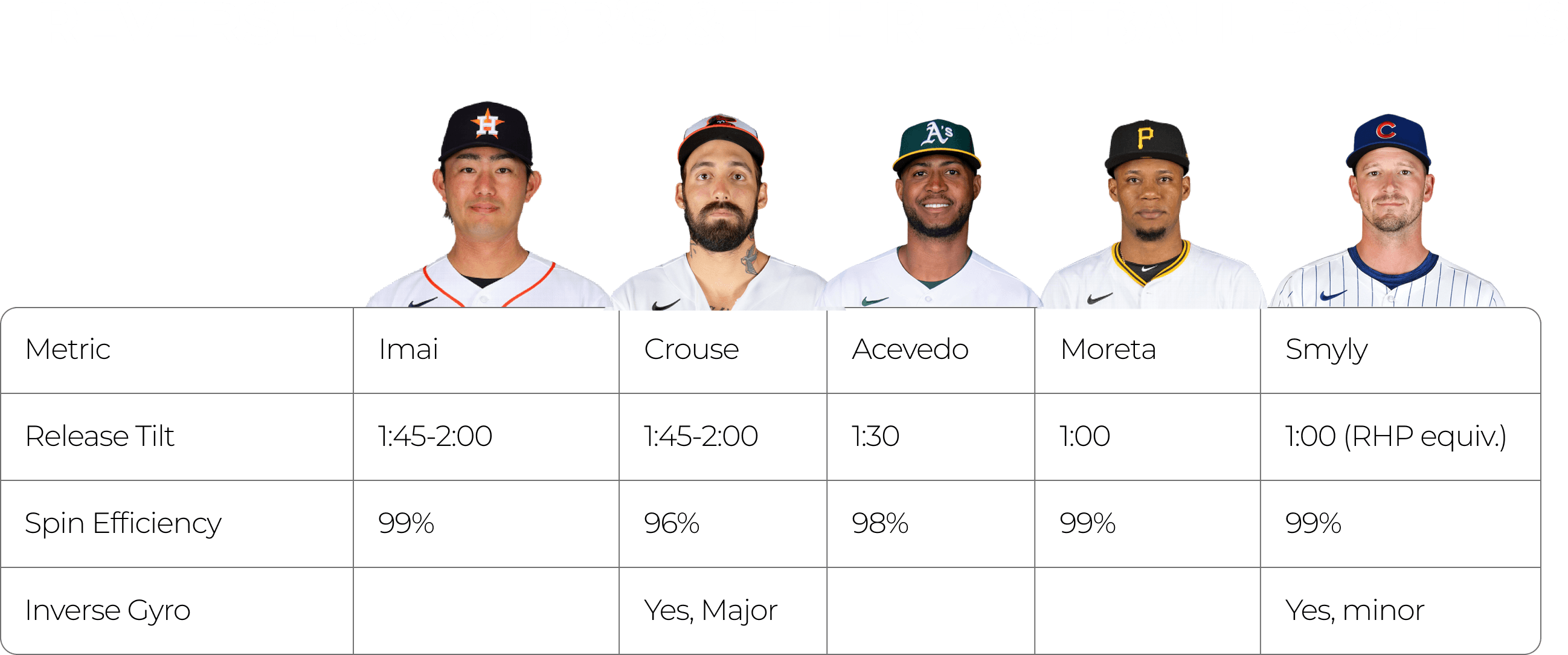
The confirmed throwers in this bucket share something that isn't immediately obvious from the movement data alone. They are, almost without exception, high-pronation pitchers — arms that either sit near 100% fastball spin efficiency or are actively inverting their fastball spin to some degree. Imai, Moreta, and Acevedo sit at the high-efficiency end. Crouse and Smyly represent something more extreme — their lower spin efficiency on their primary pitch isn't a weakness in the conventional sense. It's a product of pronounced pronation through release, the same mechanical pattern that enables the arm-side gyro breaking ball in the first place. A lower efficiency number on a Crouse sinker or a Smyly two-seamer is not a pitcher failing to achieve conventional spin. It's a pitcher applying so much pronation that the spin axis has inverted relative to what you'd expect. That's a meaningfully different thing.
The inverse is also true, and probably underappreciated. A pitcher who naturally supinates — who achieves conventional slider shape cleanly and efficiently — is likely too good at producing the expected spin pattern to ever accidentally develop this. The arm-side gyro requires the fingers to get in front of the ball and generate side spin in a pronation direction. For a natural supinator, that is genuinely difficult to replicate. Not impossible, but sufficiently unnatural that it is unlikely to emerge organically and unlikely to be easily taught.
What this suggests is that the bucket is not randomly distributed across the pitcher population. It is biased toward a specific mechanical profile. And it's worth asking whether some of these pitchers exist in the arm-side gyro bucket not because they set out to develop the pitch, but because their natural arm action made the conventional slider shape difficult to achieve consistently — and over time they simply settled into something that worked, without fully understanding why.
One name worth flagging before moving forward — Trey Yesavage. He's missing from the data here due to insufficient regular season reps. His slider shares some of the arm-side gyro characteristics, though with more vertical than horizontal movement. Part of that has an explanation: his release height at 7.15 feet is generating a vertical approach angle that flatters the pitch beyond what the raw metrics suggest. At 88.5 mph with 4.5 inches of depth, the release height is doing real work. The sample is roughly 250 major league pitches — not a stable true talent read yet.
What Yesavage adds to the picture is something worth documenting: the release tilt in isolation may not even be a prerequisite. What matters is pronation within the observed dataset. Moreta, Imai, and Yesavage collectively cover this pitch from roughly 12:30 — near all backspin — through to the predominantly side-spinning fastball release observed in Imai and Crouse at 1:45–2:00. That is a wide range. Wide enough to suggest that the arm angle itself is not the filter. The pronation profile is.
All of which points to a relatively clear first-order targeting mechanism for development: high-pronation arms, high fastball spin efficiency, and ideally some evidence of inverse gyro tendency in the fastball profile. That is the group most naturally positioned to develop this pitch. And within that group, the subset without a reliable breaking ball carries the highest incentive to try.
PART V — Candidates to Develop It
The pronation precondition is the first filter. The second is whether the current breaking ball is working. A pitcher posting a .360 xWOBA and a sub-25% whiff rate on a conventional slider is being told something by the data — and if the pronation precondition is present, the development conversation has a clear starting point.
How this actually gets employed in practice matters. This kind of pitch doesn't enter the game through a front office memo or a top-down mandate. It enters at a phase boundary — when the data signals the conventional approach isn't trending in the right direction and the risk tolerance conversation opens. That's effectively how velocity and stuff+ entered the game. Not through consensus-building. Performance gaps became undeniable, front offices concurred on the ROI, and development infrastructure aligned around it rapidly. The arm-side gyro is a different scale of opportunity — but the adoption mechanism is probably similar. It will move when someone decides the trial is worth running and the results become hard to ignore.
A few things worth noting before drawing conclusions. The pronation precondition being present doesn't mean the pitch is developable on a short timeline or that it should replace anything immediately. The initial instinct is that a pitcher who already competes with a changeup or splitter makes the slider use case redundant — but I'd caution against that conclusion too quickly. Imai's slider locations to right-handed hitters are that of a glove-side pitch, and it stays that way in the larger NPB sample. It may simply mimic what a regular slider does directionally while arriving with an entirely different spin signature. I have less skepticism toward that than I did when first thinking this through months ago.
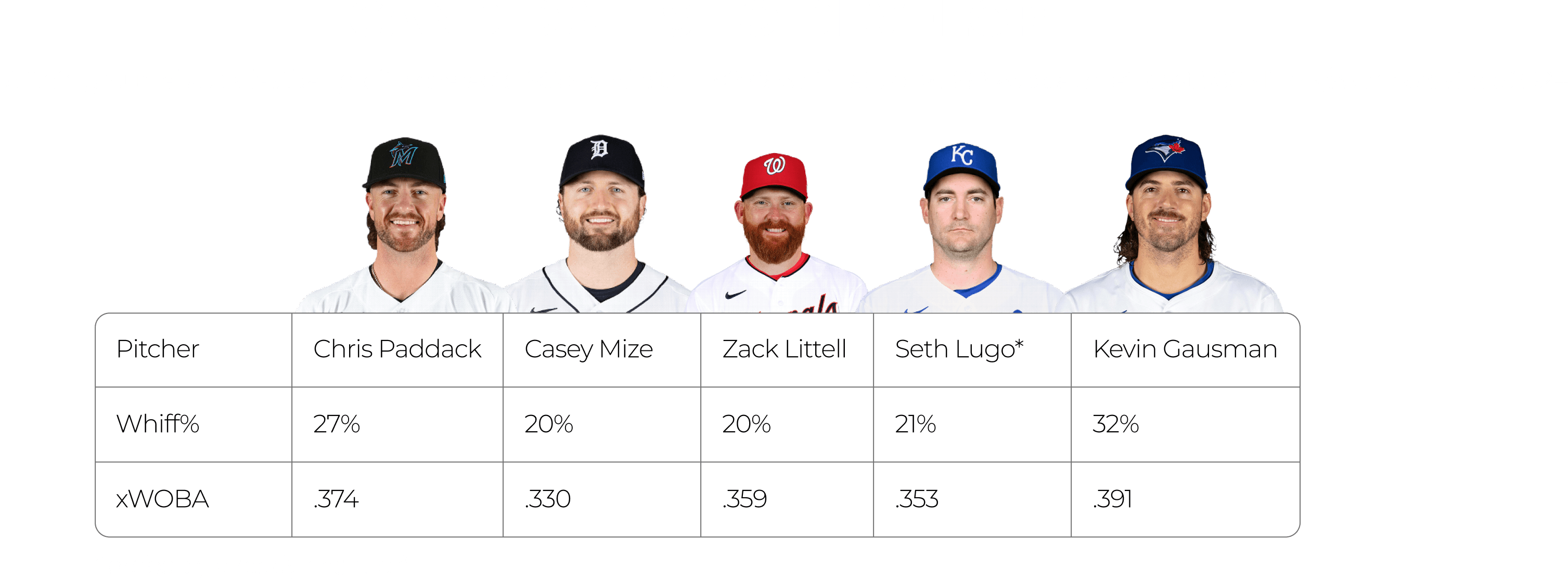
Paddack and Mize are the two names I'd flag most specifically. Paddack has never had a reliable breaking ball — release traits for the reverse gyro is there, and at a .374 xWOBA and 27% whiff rate the outcomes on his current slider make the conversation at least worth having. Mize is the more interesting one analytically: his fastball release tilt is 1:02 — essentially identical to Moreta, a confirmed arm-side gyro thrower. 867 pitches of a slider at 20% whiff and .330 xWOBA isn't a pitch that's costing him games, but if he's specifically seeking swing and miss, the arm action is there and the incentive is situational rather than urgent.
Lugo develops a million pitches, so I'm not sure my logic even needs to be airtight here. He's probably -4000 in Vegas to be the first pitcher to submit to the arm-side gyro given his general propensity to cook up new offerings and apparent lack of interest in being told what to do. The pronation precondition is present and the outcomes justify at least raising the question. Beyond that, this one largely makes itself.
Gausman is worth separating from the others. His overall outcomes are strong and the slider xWOBA is poor — but the pronation-based pitch profile is already doing the heavy lifting for him. The only reason to employ his current slider is directional, and there's no obvious reason a pitch that fades arm-side couldn't serve the same purpose while leaving the splitter impact intact. Not urgent. Worth documenting.
The minor league argument carries the most weight regardless of what happens at the MLB level. An arm with a high-pronation release, no reliable breaking ball, and development distance still to cover has the maximum incentive and minimum downside for trialing something the industry hasn't decided is worth pursuing yet. The variance cost in affiliated ball — where a pitcher is already operating in a phase defined by experimentation — is as low as it gets. Whether anyone decides the trial is worth running is what will determine whether Imai holds this monopoly for a career the way Smyly did — or whether someone in the minor leagues figures out the pronation precondition is more common than four confirmed practitioners suggests and decides it's worth a look.
Smyly held a monopoly for a career and the league never came for it. Whether that was because the pitch was intrinsically his, or because the era made the search unnecessary, is a question that probably doesn't have a clean answer. What Imai's arrival in MLB does is reopen it — in a development environment that for the first time in a while actually has reason to look.
Credits & Data Sources
Baseball Savant / Statcast
NPB tracking data
NPB Pitch Profile (via @bouno05): npbpitchprofile-stjm6eueundydvjbqfxlbv.streamlit.app
**Methodology Notes**
Arm-side gyro classification is not a Statcast pitch type. The filter applied here — spin efficiency between 25–45% with confirmed arm-side sidespin direction — uses the spin efficiency range where slider-classified pitches empirically cluster in the Statcast era. It will not appear as a named category in any standard pitch classification system.
Movement bucket averages are weighted by pitch count within each horizontal break zone. Fastballs excluded. Coors Field appearances excluded from all movement bucket average calculations.
The 75% spin identity figure referenced in Part I is derived from Imai's spin efficiency and active spin rate relative to the conventional slider population mean — not a direct Statcast output.
Word Count: ~3,800 | Read Time: ~15 minutes